




















By Aqsa Naz
Freelance Writer
Video: Dawn News/YouTube
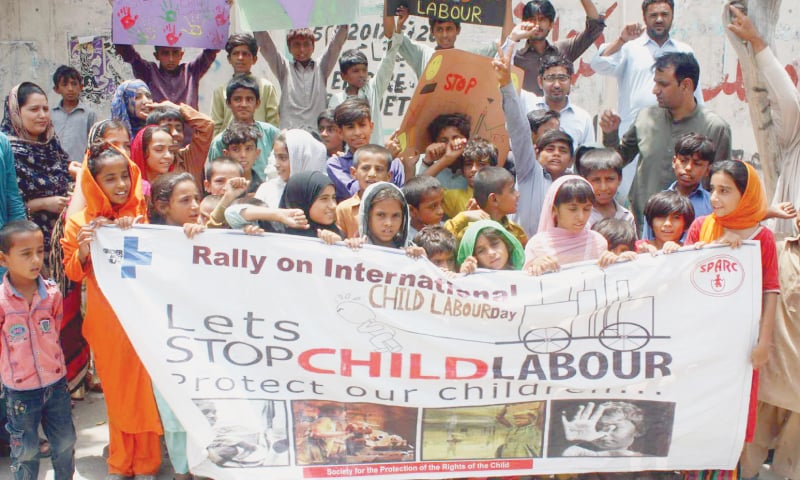
STOP CHILD LABOR
بچوں سے مُشقت بند کرو
बाल मजदूरी रोकें
Who was Iqbal Masih?
Iqbal Masih became a debt slave in a carpet factory in Pakistan when he was a child. Five years later he was set free. He gave other children the courage to leave their owners.
Iqbal was threatened by the carpet factory owners and was murdered on 16 April 1995. He is a symbol for the struggle against child labor and in 2000, he received the first World’s Children’s Prize for the Rights of the Child posthumously (after his death).

Shares message
Iqbal’ story becomes known around the world and in October 1994, he visits Sweden. Iqbal tells school children about how life is for debt slave children in Pakistan. Many newspapers write about him, and he is featured on lots of TV programs. In December 1994, Iqbal flies to the USA, where he is given an award by the Reebok company for fighting for the rights of debt slave children. Iqbal is also ‘Person of the week’ at one of the USA’s largest TV companies. At home in Pakistan, some people get angry when they see that Iqbal tells his story on TV and in newspapers. It may become more difficult to sell Pakistani rugs abroad if child labor and debt slavery are talked about around the world. And paying decent wages to adult workers instead would mean less profit for carpet manufacturers.
After Iqbal escaped from the carpet factory with a few of his friends, he decided to go worldwide and speak out to try and end child labor. Iqbal made such a huge impact on people when they hear about child labor. The way that he made all of his speeches and the fact that he actually went through this awful time in his life, was so moving. The children at the school he went to also made an organization to stop child labor, and that was because of him and what he said to all those children. He has changed what people think about when they think about child labor and he made them want to help.

This cause is important because as a child, you should be running around and playing, not working. It not fair for children to be “robbed” of their childhood and have to go and work. Also, none of the kids want to be working, they just don’t want to get in trouble and have something bad happen to them. These children need to all be freed around the world. These children are working for so long, and so hard, but they are only getting payed from 10-20 dollars a week.
Iqbal was put through child Labor from age 4-10 and he only made about $12 per week. At age ten, he managed to escape and flee to America. In America, he joined a school and class to start and get an education. There, he told all the students about his horrible experience. Eventually, Iqbal had to leave the class and return back to Pakistan. When Iqbal left, his class made an organization that was trying to fight against child labor. It was called, “A Bullet Can’t Kill a Dream”. But, when Iqbal returned to Pakistan, he was shot by the owners of the carpet factory, outside of his grandmothers house.
The lie spreads
The Human Rights Commission of Pakistan confirms that the police report is correct and that Hero, an innocent man, is the murderer. As a result, the lie is spread all over the world by ambassadors and journalists, without being questioned. The Human Rights Commission also claims, without proof, that the murder is nothing to do with the fact that Iqbal challenged the carpet makers.
The farmer, Hero, is kept out of the way. No one is allowed to meet him. But in court he is found not guilty. The police write that Hero, who has never before held a rifle, just happened to hit Iqbal when he fired in the general direction of the boys. In actual fact, Iqbal was hit by 120 pellets on his back, while the other boys were only hit by a total of two pellets. Iqbal was the murderer’s target, and he was shot in the back when he tried to escape.

Iqbal Masih was a young boy who was stuck in child labor for pretty much his whole childhood. When he escaped the carpet factory, he went worldwide to try and put a stop to child labor. He was a very important activist. I am interested in this cause because so many people my age in different countries are put through child labor. I am also very worried about this topic because in any country, child labor can happen to anyone. He sacrificed his life many times to save all the kids from child labor.
GOAL!
Since Iqbal is dead, he doesn’t see change in the future now. But, when he was younger, and traveling the world as an activist, he saw that in a little bit of time, child labor wouldn’t exist. Something about Iqbal is that he was never negative. He always thought something good would come out of everything. He believed that no matter what, he could fix this problem, with a little bit of help. He always believed in himself and everyone else.

Child Labor in Pakistan
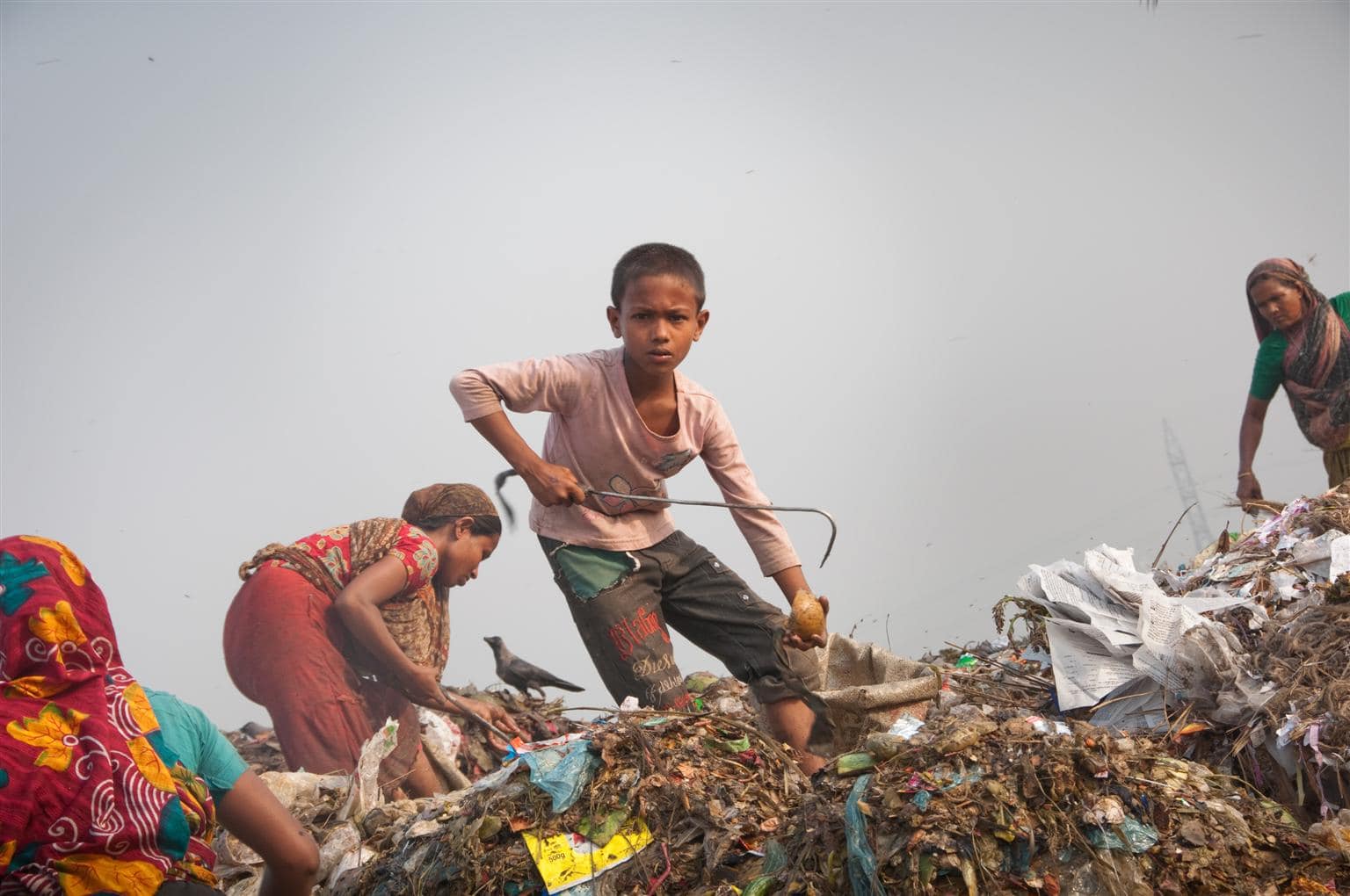
My research is all about child labor in Pakistan. What is Child Labor? Mainly children work in small ages because of their family’s poor economic condition. Also there is no concept of education. As the child grows, their parent thinks he should work for some money, so that they can live and eat. Also according to government research, there are average 8 persons in the home of child’s who is working as labor. They usually live below the poverty line.
Every child deserves a peaceful and secure childhood and the chance to go to school. This is still being denied to 152 million girls and boys around the world who are engaged in child labor, many of whom are suffering the worst forms of child labor. From the most recent Global Estimates of Child Labor of 2017, there are 73 million children involved in hazardous work, that directly endangers their health and safety. Hazardous work can cause death, serious illness or injury, permanent disability or psychological damage, as a direct consequence of poor safety and health standards, exploitation or abuse.

Children can work in dangerous conditions in all sectors, including agriculture, mining, construction, manufacturing, the service industry, retail and domestic service. However, agriculture is where the highest incidence of child laborers are found (71%) and it is a sector particularly prone to dangerous conditions, especially for children. For example, hazardous work in cotton production is among the worst forms of child labor, as children are exposed to harmful pesticides (as indicated by ILO Convention 182 on the Worst Forms of Child Labor, which was universally ratified in 2020). See the example below of how the EU is helping protect children from these dangers under the Clear Cotton project, implemented by the ILO and FAO.
The ILO estimates that some 22,000 children are killed at work every year. However, due to the fact that much of child labor is hidden, it is difficult to obtain accurate data on how children are being affected. For instance, the numbers of those injured or made ill because of their work are not known.

This is even more reason to stamp out the practice of child labor altogether. Children are some of the most vulnerable members of society and those involved in child labor face significantly increased vulnerability, given their situation. Children working in difficult and hazardous conditions, suffer higher levels of illness and injury. They are more at risk than adults to workplace hazards because of their age and level of development. As a consequence of hazardous work, a number of serious diseases appear
only in adulthood and are often more devastating and are more likely to cause permanent harm.
Children involved in hazardous work may work at night, over long hours, be exposed to physical, psychological, or sexual abuse, and have to work in dangerous situations, such as underground, underwater, at dangerous heights, heat, cold or in isolated and confined spaces. Some children have to operate unsafe machinery, equipment, and tools, or be required to lift heavy loads and be exposed to hazardous substances, agents, or processes, or to temperatures, noise levels, or vibrations that can cause serious damage to their health.
There is also a gender dimension to hazardous work or worst forms of child labor. For instance, girls are
more likely to perform heavy domestic work and be subject to sexual abuse and exploitation, while boys are more likely to be involved in dangerous work in agriculture, operating heavy machinery, or chemical people take disadvantage of innocence child they use harsh behavior and biting them many of child have killed by the hand of owner . No one cares about that child’s who suffer for their hunger no one help them for their education and growth of future.
Children involved in child labor are more likely to experience worse health outcomes also later in life. The impact of Cancer, infertility and chronic backpain are just some of the possible long-term negative health outcomes. The consequences are worsened by poverty and the lack of efficient health and social security schemes.
First and foremost, child labor should be stamped out, especially in its worst forms. The international community, including the European Union, has committed to the eradication of child labor .
The Sustainable Development Goals sets the target of ending child labor in all its forms by 2025 (SDG target 8.7). However, this is increasingly looking less likely. This is why we need renewed commitments and efforts by all, especially by governments where there is high prevalence of child labor, the private sector involved in supply chains that involve child labor, civil society and other stakeholders. The solutions are known, it is the commitment and resources that need reinvigorating.
In terms of health, there needs to be trained and sufficiently resourced health and safety or child protection officers to respond to the health and safety impacts on child labor. While the elimination of child labor is the ultimate goal, in the interim, when child labor is still prevalent, we must do our utmost to prevent injury, harm or even the death of children involved in child labor.
When children are freed from the burden of child labor, they are able to fully realize their right to healthy development! Children have also right for good education government should take part to use policies for give them education free of cost that they can live a better life without any pressure by people.
Under the Sustainable Development Goals (SDG), Pakistan has committed to take immediate and effective measures to eradicate forced labor, modern slavery and human trafficking as well as secure the prohibition and elimination of the worst forms of child labor, including the recruitment and use of child soldiers and by 2025, end child labor in all its forms.
According to the statement, a large number of children still constitute a significant part of the labor force in Pakistan. Legislation relating to child employment are still not aligned with Article 25-A of the Constitution which gives each child a right to education and the employment of children remains unaddressed, particularly in sectors like agriculture, factories, small car workshops, shops, hotels, cinemas, vending on the streets, the fishing industry, mining, brick kilns, weaving, bracelet making, packing and construction etc.
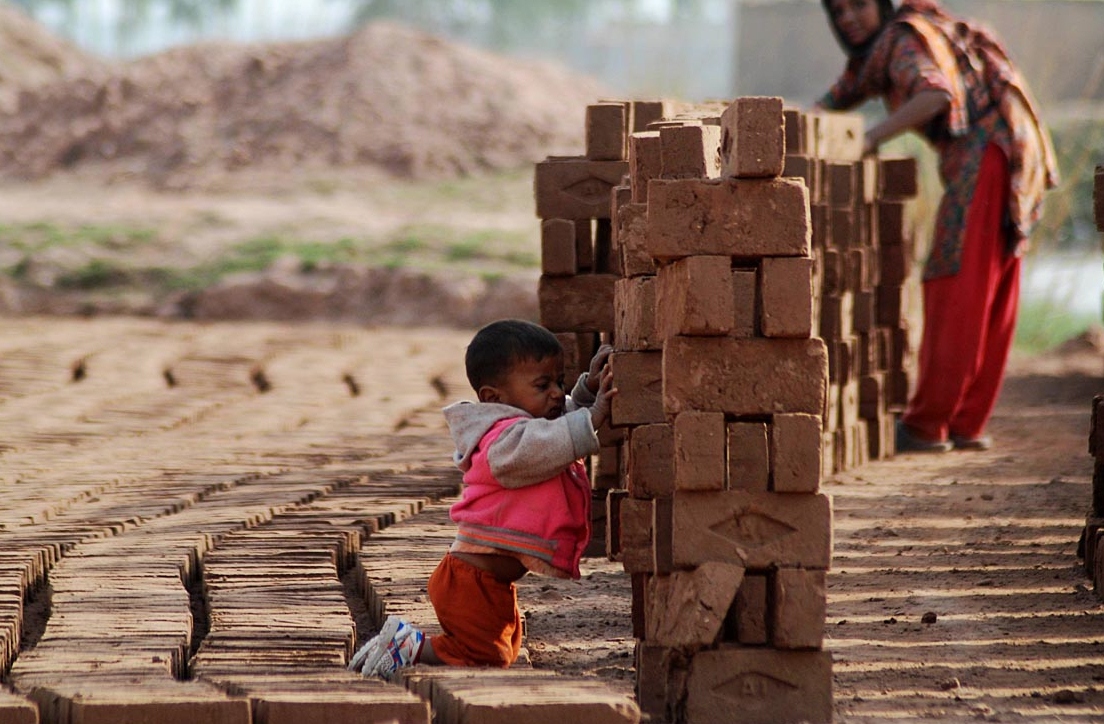
The statement claims that a large portion of these children are employed through an informal economy in the street, in private structures or in their homes, which also deprives them of any form of safety and recognition.
Denying children their fundamental right to be educated between the ages of five to 16 exposes them to health hazards, hampers their development and puts them at risk to other forms of violence, which may also be physical, psychological and sexual, the statement says.
It goes on to say that children in the labor environment are highly vulnerable to exploitation including commercial and sexual as well as trafficking.
When it comes to education Pakistan ranks as the country with the second highest number of children not attending school. A major reason for this is poverty which forces parents not to send the children to school but to put them to work so they can earn some money. Our children are being deprived of their basic right. It is the duty of the federal and provincial governments as well as the policymakers to take steps to eliminate child labour and to ensure that all children attend school.
The need of the hour is to enforce labour laws and discourage child labour, so that our future generation will be able to play their part in the development of the country. In a nutshell, it is imperative for the government and concerned authorities to take decisive measures to eliminate child labor so that Pakistan can achieve a better position in world economies.

“We, Pakistani citizens, cannot wait any further to provide those little citizens with respect and decency and cannot reasonably agree to sacrifice a significant portion of our next generation if we wish to create a prosperous Pakistan in line with SDGs and with the challenges of the 21st century. We therefore demand to the Pakistani government at provincial and national levels to take steps to abolish child labor,” the statement says.
“Child labor has no place in well-functioning and well regulated markets, or in any supply chain. The message that we must act now to stop child labor once and for all has been affirmed by the SDGs. Acting together, it is within our means to make the future of work a future without child labor, ” ” said ILO Director-General.
Iqbal’s quotes
One of the very famous quotes that Iqbal Masih said was ” I want to do what Abraham Lincoln did. . . I want to do it in Pakistan.” it showed how determined he was about helping this cause and to end child labor.
Another famous quote that Iqbal said was, “Children should have pens in their hands, not tools.” It shows how he doesn’t think that kids should be working and they should be doing normal kid things like going to school.
Neither Sada-e-Watan (Melody Media Productions) nor its sponsoring partners make any warranties or representations as to the accuracy, applicability, completeness, or suitability for any particular purpose of the information contained herein. Sada-e-Watan (Melody Media Productions) and its sponsoring partners expressly disclaim any liability arising from the use or misuse of these materials and, by visiting this site, you agree to release Sada-e-Watan (Melody Media Productions) and its sponsoring partners from any such liability. Do not rely upon the information provided in this content when making decisions regarding financial or legal matters without first consulting with a qualified, licensed professional.