













USA

USA

INDIA

India

BANGLADESH

BANGLADESH

NEPAL

Nepal

FIJI

FIJI

PAKISTAN

Pakistan

Melody Media Productions

Excellence in Broadcasting!

Pervez Saleem

(Producer/Director)

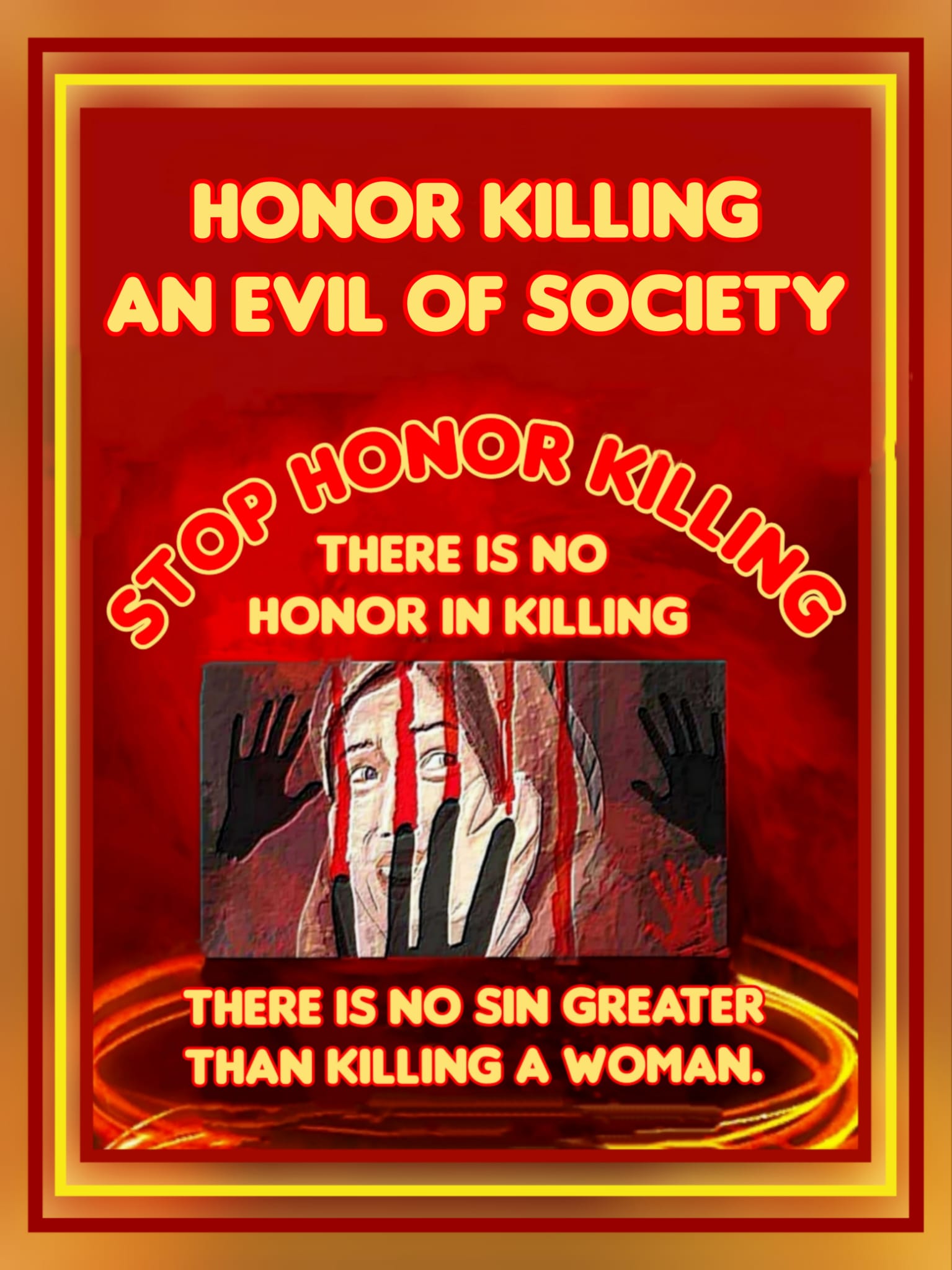
Stop Honor Killing

Silent Wounds, Loud Cries: Violence Against Women in Pakistan

By Maryam Shahjehan
Content Writer
By Asma Ali
Master of Arts (MA)
English Literature
Video: Express News
YouTube

Silent Wounds, Loud Cries:
Violence Against Women in Pakistan
خاموش ذخم، اُونچی چیخیں
پاکستان میں خواتین کے خلاف تشدد
खामोश ज़ख्म, तेज़ चीखें:
पाकिस्तान में महिलाओं के ख़िलाफ़ हिंसा

“With every slap unheard, every cry ignored, a wall is erected between justice and women in Pakistan.”
“The shame is not in a woman’s suffering; the shame is in a nation’s silence.”
“There is no place to feel safe if there is no justice from the home to the street.”
“The most deafening scream of a society that is deaf to the cries of women is Femicide.”
“There is no honor in bloodshed; there is no culture that flourishes on a graveyard of its daughters.”

Stop violence against women Vectors - Download Free High-Quality Vectors  from Freepik | FreepikIntroduction:

Violence against women can be defined as outlined by the United Nations Declaration on the Elimination of Violence against Women (1993):

“Violence against women is any act of gender-based violence that results in, or is likely to result in, physical, sexual, or psychological harm or suffering to women, including threats of such acts, coercion or arbitrary deprivation of liberty, whether occurring in public or private life”.

The term “violence against women” can also be defined as “the harassment or killing of women or girls by men due to hatred, contempt, pride, satisfaction, or a possession of females”.

The purposeful killing of women and girls because they are female, is not only one of the most extreme and visible forms of gendering against women, but it is also a significant and widespread problem across many societies and regions of the world. The manifestations of this violence can take the form of domestic violence, honor-based killings, or conflict- related sexual violence; all of which illustrate the fact that women experience higher vulnerability due to unequal gender relations and are often overrepresented in these forms of violence against women.

As we have seen, thousands of women continue to be killed due to gender-based violence, leaving families shattered and communities grieving and traumatized; despite global commitments to put an end to gender-based violence.
There are different types of violence against women:

1- Physical violence includes beatings, burnings, acid attacks, slaps, killing, etc.
2- Sexual violence includes forced prostitution, marital rape, rape, and marital harassment.
3- Psychological violence includes humiliation, verbal abuse, isolation, and threats.
4- Economic violence like financial control, withholding funds, and failure to facilitate work or education.
5- Cultural violence includes dowry abuse, female genital mutilation, honor killings, and forced marriages.

There are various causes of violence against women:

Male dominance, toxic customs, and poor enforcement of the law are causes of violence against women in Pakistan. Many women are uneducated, depend on men financially, and do not know their rights. Child marriage, dowry abuse, and honor killing are prevalent acts. The victim blaming and tribal customs only intensify their suffering. Male drug addiction is also one of the major causes of violence.

In Pakistan’s bustling cities and sleepy villages, there is an invisible war occurring in the shadows, which costs innumerable lives, but lacks a battlefield. This battle is not with guns, but fists, silence, humiliation, and centuries of patriarchy. The victims are not soldiers, they are mothers, wives, and daughters, and their suffering is hidden in plain sight behind silence, legal indifference, and cultural rationalizations. Women are silenced every day, in public and behind closed doors, not just by their abusers, but by a system of complicity that remains indifferent to her cries. Violence against women does not happen by accident; it is systemic, a pattern, a pandemic, and a national failure, in a country that values honor over life, which uses shame against the survivor.

This article deals with the merciless consequences of gender-based violence in Pakistan. Not as crime acts, but as a symptom of something deeper and systemic. Stop asking, “Why didn’t she say something?” Now we should be asking “Why didn’t we listen?”.

Pakistan, a land of culture and proud people, is enduring a silent tragedy quickly burying its women; “violence against women” or honor killing if serious enough conjures images of someone sometimes killed for having born the wrong gender, but it is complicated in Pakistan. This is a story of women without the chance to lift a voice without it falling mute before it can be heard.

Asma Rani (above) was shot dead near her home in Kohat in 2018 for refusing a marriage proposal; earlier this month, her killer was pardoned by her fatherAsma Rani (above) was shot dead near her home in Kohat in 2018
for refusing a marriage proposal; earlier this month, her killer was pardoned by her father

This article highlights the causes, effects, and immediate steps to diminish violence as a human rights violation.

Human Rights Watch pointed out that Pakistan has thousands of honor killings each and every year and thousands more are killed and made to disappear as suicides or accidents. Any woman who has dared to refuse forced marriage, continue an education, or simply attempt to take hold of female autonomy over her own life, is killed. However, such deaths cannot be classified, per international law, as gender violence. While it is bad enough that it is an epidemic culturally speaking, it is not exclusively cultural.

Pakistan is one of the most dangerous places for women, ranked the 4th most dangerous in a 2022 poll, and has several reports of violence against women, especially honor killings and intimate partner violence. According to the Human Rights Commission of Pakistan (HRCP), in recent years, there have been at least 400 honor killings documented annually, and the provinces of Punjab, Sindh, Khyber Pakhtunkhwa (KPK), and Balochistan saw cases of honor killings from all provinces. Arguably, rural areas are far more vulnerable to these crimes.

“A society which tolerates violence against women is one that values power more than peace, control more than compassion.”

- Photo by Emaan Rana / White Star (The photo is a re-enactment using actors).

Qisas and Diyat laws allow families of the victim to claim the qisas– and in ransom, the guilty party receives gain. Because the victim is typically a close relative, often of the same family, this effectively legalizes ‘honor killings’ without any consequences.

The Zina Hudood Ordinance of 1979 has a far-reaching impact on women’s safety in Pakistan as it indirectly fostered the killing of women in a culture of injustice and misogyny. The Zina ordinance blurred the lines between what is rape and if consensual relationships occurred outside of marriage, while making it impossible to criminally convict for rape (four male witnesses required). This caused women to hesitate to report assaults, as they would be exposing themselves to further violence.

The law also included women who could not demonstrate rape as criminals and put them at risk of severe punishment and social stigma. In many cases, the families related accusations of zina (adultery) with killings in the name of honor, a common type of violence.

“Boys are taught to be ‘strong’, aggressive while women are taught to compromise.”

As the scariest facts hide behind statistics, so does the voice of each and every victim. It would be impossible to relive every violation here, but I will try to highlight some incidents as an attempt to show the range of this cruelty, if not in totality, at least in part. And, perhaps if not many; at least, a few, can wake up to reality.

Violence Against Womens Images - Free Download on Freepik


The murder of women can take many forms, often beginning with the most innocent and helpless victims. There is a particularly chilling example in the case of a 15-day-old baby girl. In Naushahro Feroze a father named Tayyab was arrested for the alleged crime of burying his 15-day-old daughter alive. The reports say that the infant was tied in a sack before she was buried. He confessed that he wanted to have a baby-boy and did not wish to waste his time and money on a useless girl.

In 1999, Samia Sarwar, a 28-year-old woman, was killed by her family on the pretext of resuming her divorce from her abusive husband. The family regarded her divorce as “dishonor” to them. She was murdered while on the premises of the office of her lawyer and human rights activist Hina Jilani, in a meeting which was arranged under the pretext of collecting her divorce papers.

In 2002, Mukhtaran Mai, a rural Pakistani woman, was gang-raped by four men, upon the orders of a tribal council, as punishment for a purported crime committed by her brother, in Meeranwala, Muzzaffar Garh district.

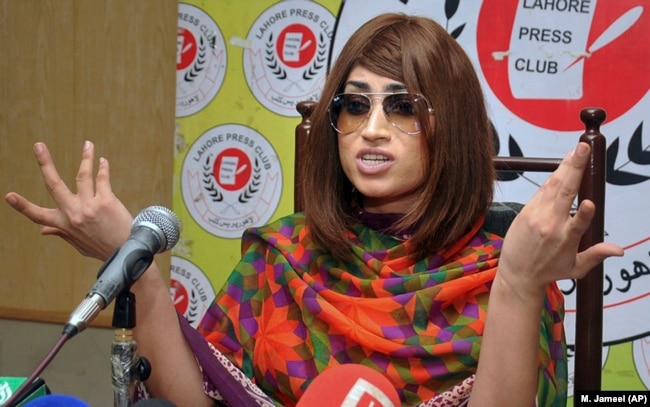
On July 16, 2016, 26-year-old social media influencer Qandeel Baloch was murdered by her brother because her behaviour was considered “intolerable” and he was “disgraced”. Her death signaled an important moment for the younger feminists, highlighting honour-based violence in Pakistan.

Noor Mukaddam, the 27-year-old daughter of a diplomat, was tortured, raped, and decapitated by her friend Zahir Jaffer on July 20, 2021 in Islamabad.

“The most dangerous place a woman can be, should not be her own home.”

In November 2024, in Daska in Sialkot District, a 30-year-old pregnant Zara Bibi was murdered by her in-laws. Her mother-in-law, Sughran Bibi, sister-in-law Yasmin, and Naveed, a relative, all participated in the murder of Zara. They strangled Zara, mutilated her body, and disposed of it in different parts of Daska. After four years of marriage to Qadeer Ahmed, Zara Bibi had a two-year-old son. In this case, the motivation was jealousy, with unfounded allegations of witchcraft against Zara.

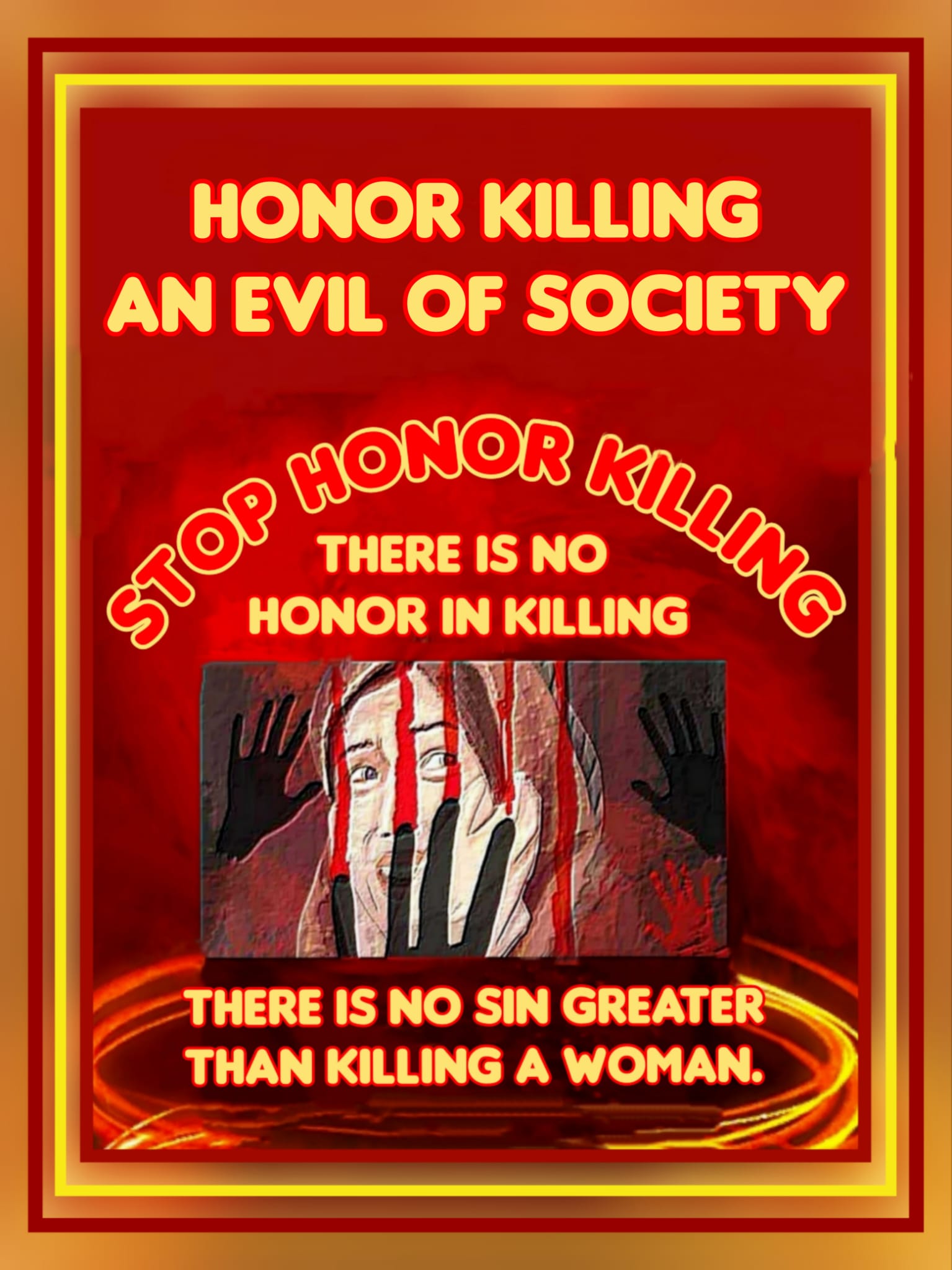
Honour KIlling Poster #2 edited

The Shah Latif Town murder case in Karachi, November 2024, involves the incident of domestic violence, and an alleged “honor killing.” A 43-year-old woman named Parveen was brutally killed by her husband, Ali Hasan Sheikh, using a hammer and knife. The offence took place at their rented accommodation, where she had recently been living alone with her husband, after sending their five children off to their village Larkana days prior to the violent attack. The husband has already admitted to murdering his wife and claimed she was supposedly having an extramarital relationship.

Pakistani stage actress Nargis (Ghazala Idrees) has alleged that her husband, police inspector Majid Bashir, physically abused her. This abuse started after she denied him her property (including a farmhouse and gold) when he demanded it.

In a tragic case of gender-based violence, Safoora Taimur, a school teacher in Multan’s Gulzaib Colony, was shot and killed by her neighbor, Aun, after she rejected his marriage proposal. The police arrested Aun, who had been harassing her, within 24 hours of the incident.

In Noorshah village in Sahiwal, Mohammad Asif shot his two sisters, purportedly in a suspected “honor killing,” as he questioned their honorable lifestyle. Mohammad Asif, had previously killed his mother, but that crime was forgiven under the laws relating to family forgiveness, a system that often absolves offenders of such crimes in Pakistan.
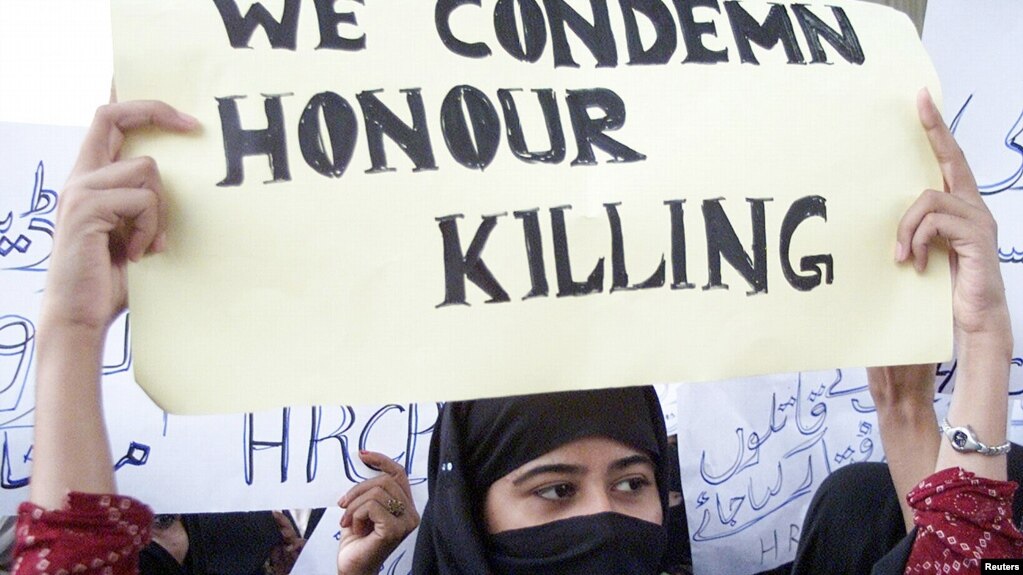
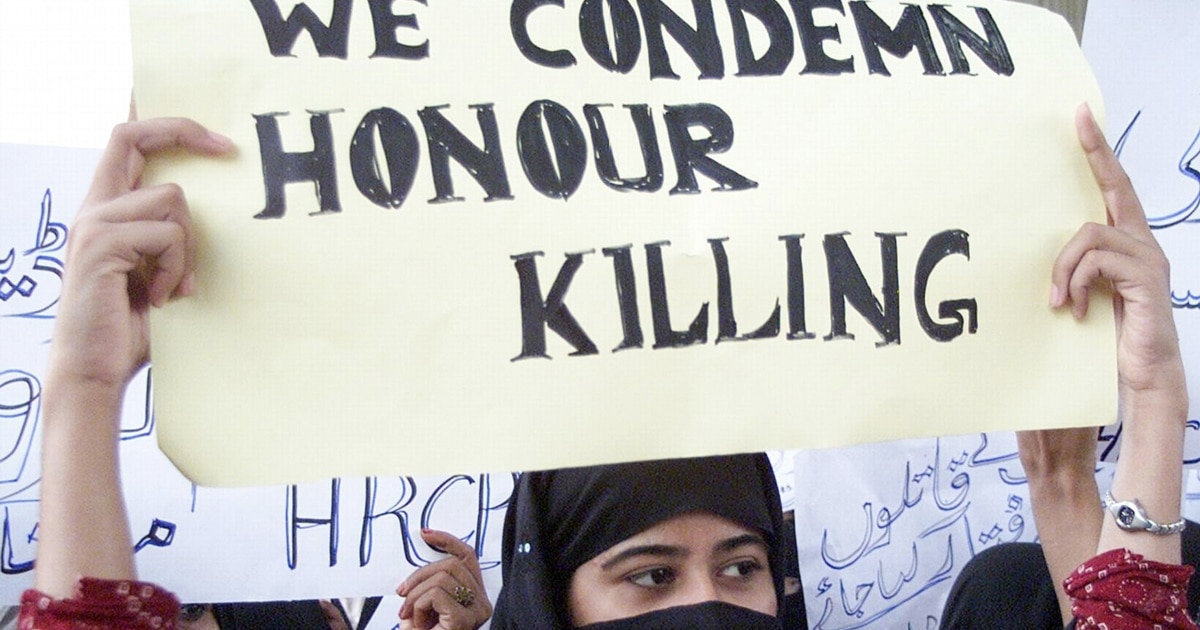
FILE - A Pakistani woman holds a placard during a protest against honor killings in Multan, Oct. 27, 2004.

On July 9, 2024, the Sania Zehra case in Multan involves barbaric murder, falsely labeled suicide. Forensic evidence demonstrated she had been tortured viciously with two broken ribs, crush injuries to her feet, and a severed tongue. Her husband, Ali Raza, is alleged to have killed Sania over issues related to property, parents involved. Authorities face outrage across Pakistan with demands for justice.

This is a day to day visual representation of the recovery of the Abuse I have seen. I take this opportunity to thank everyone who has supported me shown concerns about my

Local TV anchor Ayesha Jahanzeb suffered physical injuries at the hands of her husband, Haris Ali, during marital trouble in Lahore.

On July 15, 2025, veteran Pakistani TV anchor Jasmeen Manzoor shared graphic images on X (formerly Twitter) showing swelling and bruises on her face. She claimed these injuries were caused by her ex‑husband, who she described as a violent individual . A timestamped image suggests that the alleged assault occurred on June 4, 2025 .
Pakistani TV anchor Jasmeen Manzoor posted bruised images on X.(X/@jasmeenmanzoor)
On July 30, 2025 – Bodies of Sajid Masih and Sana were found a day earlier; murder case registered. Police registered an FIR regarding the murder of Sajid Masih and Sana, whose bullet-riddled bodies were found at Clifton beach on Monday. A major development has emerged in the case involving the discovery of the bodies of a young man and woman near China Port. DIG South Asad Raza revealed that a Karachi police team traveled to Gujranwala and arrested four individuals, including Waqas, the brother of the deceased girl, Sana Muhammad Asif. In a deeply troubling incident that has drawn national concern, the bodies of a young interfaith couple were discovered near the China Port area of Karachi. According to reports, the deceased have been identified as Sajid Masih, a Christian man, and Sana Asif Warraich, a Muslim woman. Both were originally from Budha Goraya village in Gujranwala, Punjab. This heartbreaking incident reflects the dangerous consequences of religious intolerance and deeply rooted societal prejudice. Interfaith couples, especially those involving minority communities, continue to face serious threats to their safety. The government must take decisive action to protect such vulnerable individuals.

On Aug 4, 2025 – A teenage girl was gunned down allegedly by her uncle on Monday in a ‘honor’ killing case in Khyber Pakhtunkhwa’s Battagram district. In the FIR, the suspect confessed that he had been a guest at his brother’s house for two days. “My brother went outside at night and told me to take care of the house,” the FIR quoted him as saying. He further said that he heard the sound of the gate of the house opening at around 2am, prompting him to wake up. “Using a flashlight, I saw that my niece was at the gate and going out with three people.” Upon seeing his niece leaving the house, he fired at the victim and the cartridge ran out, the FIR read. The suspect said that the victim’s mother gave him a pistol, adding, “After chasing them, I deliberately fired at Zahida Bibi out of honor.”

The firing killed the girl and injured one boy, while the other two people fled the scene, the FIR said. The police arrested the suspect and recovered the weapons used in the crime.

On September 24, 2024, in Harbanspura Lahore, Lady Constable Soman, 27, was killed by her jealous colleague Constable Farooq for marrying someone else.

In Karahi’s Sohrab Goth, in an “honor killing” Dr. Rafiq and son Abdullah shot Laraib and her friend Hassan adjacent to Sachal Police Station.

In June 2025, Sana Yousaf, a 17-year-old social media influencer, was ruthlessly gunned down in her home in Islamabad by 22-year-old Umar Hayat, a man she had rejected on multiple occasions. The assailant went into her house and shot her twice in front of her family, reportedly driven by feelings of obsession and rage over delivering her offer of friendship. He was arrested and confessed, but the legal processes are still incomplete. This case is another reminder of the obvious hostility and violence that many women face for not conforming to aspirations of desire and ownership.

In June 2025, tribal jirga held Bano Bibi, mother of five, and Ehsanullah, father of six, responsible for allegedly having an illegal relationship, leading to their brutal shooting in a remote area near Quetta, Balochistan. Forensic pathology reports confirmed that both Bano Bibi and Ehsanullah had numerous gunshot wounds. At least 14 suspects, which included family members and tribal elders, were arrested in connection with the case. The horrific details of this case demonstrated the continued use of illegal jirgas, continued prevalence of honor killings and the state’s inability to protect women from gender-based violence in tribal settings (nearly 50% of Pakistani women still experience violence of various types).

Screengrab of viral video shows tribal members carrying out “honour killing” at unknown location in Balochistan. — XScreengrab of viral video shows tribal members carrying outz
“honour killing” at unknown location in Balochistan. — X

On July 30, 2025 – A couple, who contracted a court marriage seven years ago, was brutally murdered by gunmen in Balochistan’s Mastung district which is said to have been carried out by the woman’s brothers. This is the second shocking incident to come from Balochistan in less than a month. Previously, a video went viral, which showed a group of men forcing a couple out of a vehicle and leading them into a desert, where they were shot at close range following orders of a tribal jirga in Degari.

Meanwhile, the Mastung married couple, who were in their late 20s and originally residents of Panjgur, were shot dead at a local hotel in Lakpass area of Mastung, according to the Levies officials.

The victims were identified as Muhammad Shoaib and his wife, who contracted a love marriage seven years ago, which had later been accepted by the woman’s family following reconciliation.

In another horrific case from Lyari, Karachi, a 19 year old woman died as a result of extreme level sexual violence inflicted on her by her husband just weeks after their marriage. The violence sustained by the victim led to her hospitalization on July 4th 2025, with severe internal injuries, reportedly from barbarically severe marital rape and physical assault, including severe assault with a metal object. While medical professionals attempted to save her, the victim tragically died from her injuries on July 23rd, making her a beautiful reminder of the manifestations of violence many women are subjected to in their homes.

Gender violence illustration concept | Free Vector


In July 2025, a new bride from Rawalpindi’s Pirwadhai area was alleged to have been murdered in the name of honour following a family jirga. Her husband had originally said that she died suspiciously, but investigations revealed signs of foul play. The case is a tragic reminder of how deeply embedded honour-based violence is in the fabric of Pakistan. This is often assisted by silence and community complicity.

Violence against women, specifically the gender-motivated murder of women, is something experienced by women all over the world, including the Pakistani diaspora. Some Pakistani men come from societies where they have stronger legal protections against violence, but since they still hold patriarchal beliefs and cultural norms regarding ‘honor’, they can be prone to violence against women. These cases show the need for some self-reflection, cultural change, and respect for fundamental human rights to protect the safety and dignity of women, wherever they are.

For example, in London, on April 29, 2023, Amin ur Rahman, 46, strangled his wife, 24-year-old Suma Begum, in front of their children, after being angered by her online relationship with Shaheen Mian in the UAE. Rahman filmed portions of the murder on a video call, before placing Suma’s body in the River Lea inside a suitcase, where it was found ten days later. Rahman was found guilty of murder and was sentenced to life imprisonment.

Sara Sharif, a 10-year-old child from Surrey in the UK, was found dead on August 10, 2023 with more than 70 injuries including fractures, burns, and signs that she endured abuse for an extended time. Her father Arfan Sharif, his partner Beinash Batool and brother Faisal Malik fled from the UK to Pakistan but were later arrested and returned to the UK. Arfan did admit to using more than what he described as “excessive” “discipline” tactics with Sara. Evidence of systematic abuse against Sara was uncovered, warning signs of abuse ignored by teachers and child protection services reinforced how easily situations like Sara’s can slip through the cracks.

These incidents point to the fact that both housewives and autonomous women are victims of violence , the only requirement appears to be a woman.

Stop violence against women international violence against women awareness day | Premium AI-generated vector

There are countless nameless women from rural Sindh, Balochistan, and Khyber Pakhtunkhwa provinces, who are regularly murdered, their deaths being labelled as ‘karo kari’ honour killing. These women, excluded from education and justice, while the inaccurate stories of many do not even exist, are erased from existence, to be forgotten about.

These examples demonstrate that women and girls suffer horrific violence, more commonly than not committed by their protectors—fathers, husbands, and other family members. Combined with a legal justice system that continues to fail at adequately addressing these cases, and the cogs and wheels of a patriarchal system that wants to reinforce itself, the cycle of violence will only continue on, across women, of all ages and backgrounds in Pakistan.

The Pakistani femicide can be traced back to the mythology of honor called for its people “ghairat”. As far as the context looks dreary, there is still a glimmer of hope with the engaged citizens of civil society and different organizations, working hard to eliminate gender based violence in Pakistan.

Aurat Foundation and Tehreek e Niswan are the names of some of the organizations.Women are using to come forward with their stories for change.

Some of the legal change that has happened in Pakistan has been the passing of the 2016 Anti-Honor Killing Bill, but implementation to date is still quite limited and many social/cultural barriers remain in the way of true reform.

In order to eliminate violence against women in Pakistan, there needs to be an intersectional action plan. With education and women standing to gain their independence, the most recent legal change which includes changing laws needs to be supplemented with a commitment to implementing the provisions of the new law so that those implicated in violations of the law can be punished.

An equally important aspect is to change the culture in the country too. We cannot change patriarchal culture and practices instantaneously but constant reinforcement of women’s rights and combating toxic honor-based behavior through small yet consistent motions may turn the tide.

The global civil society must stand with the women of Pakistan, and be supportive of every grassroots step and local effort going on in the country, and they need to compel the Government of Pakistan to not shirk its duty to protect women’s rights as part of gender specifically.

“No woman should fear for their lives for saying no, forging their own path or for simply existing in the realm they choose to”.

Stop gender violence illustration | Free Vector


Conclusion:

This article reveals a grim reality where systemic injustices and entrenched patriarchal norms perpetuate violence against women. Breaking this cycle demands more than laws; it requires a cultural reckoning, collective action, and unwavering commitment to protect the lives and dignity of women.

Together, we face some grim realities due to systemic injustices and deep-set patriarchy that manifest as violence against women. In order to break this cycle we need more than legislation, it requires soul searching, collective action, and commitment to safeguard the life and dignity of women.

The violence against women in Pakistan is no longer just a crisis or an epidemic, but a demonstration of normalised oppression that continues to be exercised on its women. Each woman silenced creates a void, the unspoken account of a woman, the future of a woman not realised.

Change takes time; Guess what? The journey will only be legitimate when the voice, strength, potential of the oppressed and unheard is seen and heard: no one is made to disappear into the smoky back-alleys of discrimination.
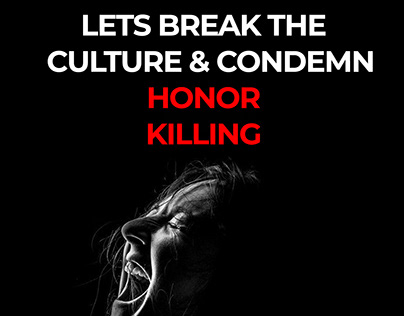
Honor Killing Projects :: Photos, videos, logos, illustrations and branding :: Behance

“A nation rises when its women are safe; it crumbles when their lives can be taken with impunity.”

“True progress is safeguarding the rights and lives of women from the home to the streets and beyond.”

For all that violence to end in Pakistan, there must be effective laws in place to punish perpetrators of violence against women. It is important to teach a culture of respect for women and help annihilate negative traditions. We need to support women through education, developing means of employment and safety, especially since women’s lives matter and must be protected.

“A nation cannot rise if half of the population lives in fear of violence and death for just existing.” 

Disclaimer:
While we hope you find this content useful, it is only intended to serve as a starting point. Your next step is to speak with a qualified, licensed professional who can provide advice tailored to your individual circumstances. Nothing in this article, nor in any associated resources, should be construed as financial or legal advice. Furthermore, while we have made good faith efforts to ensure that the information presented was correct as of the date the content was prepared, we are unable to guarantee that it remains accurate today.
Neither Sada-e-Watan (Melody Media Productions) nor its sponsoring partners make any warranties or representations as to the accuracy, applicability, completeness, or suitability for any particular purpose of the information contained herein. Sada-e-Watan (Melody Media Productions) and its sponsoring partners expressly disclaim any liability arising from the use or misuse of these materials and, by visiting this site, you agree to release Sada-e-Watan (Melody Media Productions)  and its sponsoring partners from any such liability. Do not rely upon the information provided in this content when making decisions regarding financial or legal matters without first consulting with a qualified, licensed professional. 
By Maryam Shahjehan Content Writer By Asma Ali Master of Arts (MA) English Literature Video: Express News YouTube Silent Wounds, Loud Cries: Violence Against Women in Pakistan خاموش ذخم، اُونچی چیخیں پاکستان میں خواتین کے خلاف تشدد खामोश ज़ख्म, तेज़ चीखें: पाकिस्तान में महिलाओं के ख़िलाफ़ हिंसा “With every slap unheard, every cry ignored, a wall is erected between justice and women in Pakistan.” “The shame is not in a woman’s suffering; the shame is in a nation’s silence.” “There is no place to feel safe if there is no justice from the home to the street.” “The most deafening scream of a society that is deaf to the cries of women is Femicide.” “There is no honor in bloodshed; there is no culture
Stop Honor Killing – By Aqsa Naz

By Aqsa Naz
Freelance Writer

Honor Killing in India
بھارت میں غیرت و عزت کے نام پر قتل
भारत में ऑनर किलिंग

WHAT IS HONOR KILLING?
What is the meaning of the word honor? Honor means prestige, when used as an adjective honor means special respect, when used as a noun honor means righteousness, when used in the context of cultural and societal backdrop honor is the premier asset of every person. But when referring to honor killing, honor somehow becomes a stigma, it becomes insecurity, it seems to even serve as justification for ruthlessly ending the lives of one’s own family members without even looking away, or in certain situations, without feeling regret. The moot question is who decides, what is honor? Who gets to set these standards for honor? Why honor is always to be correlated with women?

Honor killing, or killing a family member for the sake of honor that is believed to be stained
by their behavior, is a social phenomenon that can be found in a diverse range of societies
across the world. Honor killings – which refer to the murders of people perceived as bringing “shame” to their communities – are regularly reported in India. Many of the victims are young people who defy their families to marry from other religions or castes, or sometimes within the same sub-caste.

Honor killings are a product of the societal mindset that gives rise to violence against women. The publicly articulated “justification” for assault, confinement, or imprisonment, as well as interference with a woman’s choice to marry, is attributed to social order, which is said to require the preservation of the concept of honor in male (family and/or conjugal) control over women, specifically over their sexual and behavioral conduct.

To put it simply, “Honor Killings are when one or more male family members murder a member of the family.” Occasionally, though, family women are also complicit in this crime.

According to statistics from the United Nations, one in five cases of honor killing internationally every year comes from India. Of the 5000 cases reported internationally, 1000 are from India. Non-governmental organizations put the number at four times this figure. They claim it is around 20,000 cases globally every year.
20-year-old killed by uncle for marrying man of different caste
Honor is a prized possession of every human existence. In the name of culture and traditions no one gets the free license to eliminate precious human life. It can neither be forfeited for the individual interest nor for the collective interest. It is always immoral and illegal to kill someone and a gross violation of human right. It is illegitimate to take the life of someone without rhyme or a reason. It is also unconstitutional and against the law. Constitution has guaranteed to its every citizen the right to life and dignity. Honor is intact with life. This right is assured in the constitution of India as fundamental right. It is the right of every person to be protected from any type of danger to his/her life. Every individual has the right to choice. Right to opinion is also an integral part of its guarantee. Thus right to marry, choosing a partner by free will also come within the purview of right to life. The societal and cultural
pressures can not infringe the right to reside with dignity in society. But for the sake of killing under the name of honor of the family is unlawful, the legislation has provided provisions to deal with these unwarranted practices. Killing someone will never ever replace or restore the so called lost honor rather this acts amounts to murder.
The shame of ‘honor killing’ thrives with a degree of social license and an eye on maintaining ‘prestige’ of family, caste and religion, but the innocent are killed bypassing established laws.
SOCIETY: A DEADLY TRADITION - Newspaper - DAWN.COM
REASONS FOR HONOUR KILLING:
In terms of criminal orientation one can treat honor as precious and unique property possessed by each individual. It cannot be seen with bare eyes but its presence is so powerful that it encompasses the whole human behavior. When we weigh honor as property, the measuring scales can be in terms of female behavior, sexual and other aspects. In this instance, women are crucial to possessing such property, or more accurately, the concept of honor revolves around the essence and existence of women.
Thus primary reason for steadfastness of an ‘honor killing’ is conviction that the victim had brought shame to the family. There may be variations for this dishonor as it is subjective and for different families different consideration of honor will apply like for some conservative families unacceptable dress codes are prohibited and it is co-related with family prestige, for others love marriage is a taboo, one cannot decide the partner of his or her own choice, it should be strictly in compliance with parental order, non-acceptance to live-in relationships, pre-marital sex, finding out the status as lesbian, gay, third gender etc.

India has always been proud of its secularism and democracy both before and after gaining its independence. The morality of marriage hasn’t changed, though. Marriages are typically observed by families as a holy rite. Some incidents involve the horrifying and terrible waves of massacring that young, innocent women are subjected to when they choose their life partner based on their own desires and choices. Furthermore, by making this decision, the ladies expose themselves to the purportedly superior caste, religious sect, and traditional social guards. A murder committed in the name of honor instills suffering and rejects equality, two tenets of the Indian Constitution. Additionally, it illustrates how some aspects of our societal structure still uphold the values of patriarchy and feudalism.

While data is not enough to corroborate the actual numbers of honor killings that take place every year, but lets look at a few brutal killings in the recent past which are just a scratch on the surface. Although honor killing cases are more prevalent in a few North Indian states, like Uttar Pradesh, Bihar, Rajasthan, Haryana, Jharkhand and Punjab, it is being increasingly reported in the South too, including Karnataka. As per the latest data from the National Crime Records Bureau (NCRB), the number of honor killings reported in India was 25 each in 2019 and 2020, and 33 in 2021. But these figures are based on those reported, and the number could be much higher than mentioned. Honor killings have been rampant in Karnataka, including Mandya, Kolar, Tumakuru and parts of North Karnataka. From October 2022 until now, at least seven horrendous cases have been reported in the state.

Indian-origin Muslim woman murdered in suspected honour killing in UK - Times of India

According to police officials who have investigated these crimes, in most cases the perpetrators do not exhibit any sense of guilt, instead, there is a degree of pride in committing honor killings. They feel they have done something credible to protect the honor and prestige of their caste, clan or religion – which could explain why such crimes receive support from other members of the group closely linked to the perpetrators.

Honour killings – clearly, the continuing shame of India despite the country’s major advances in several domains – are powered by the status and pride among individuals over the castes, sub-castes and religions they belong to. Utmost importance is given to the ‘purity’ of the family and that of ‘sense of belonging’ to a particular social segment has led to the most abhorrent outcome of patriarchy in the form of ‘honor killings’.

1. Punjab honor killing, May 2023

In May this year, 25-year-old Manpreet Kaur and her rumoured lover 30-year-old Gurdeep Singh were found dead in Thikriwala village of Punjab’s Barnala district. A police investigation revealed that Manpreet’s father and brother killed Singh when he came to visit Manpreet at her house on a certain night, according to a report by Indian Express. The couple was allegedly together for a long time and upon finding the same, Bhola Singh and his son Sukhbir Singh attacked the man with a sharp-edged weapon and killed him. They also strangulated Manpreet to death. While Singh’s body was recovered from a small sewer drain outside Bhola Singh’s house, Manpreet’s body was found on the charpoy inside the house’s balcony.

2. Tirupati honour killing, February 2023

In February, a father in Alamuru village in Tirupati, Andhra Pradesh, after he killed his daughter, beheaded her and disposed of her body parts in an alleged honour killing. 21-year-old Prasanna Reddy had fallen in love with a local of a different caste from her village. Disapproed by her family, Prasanna was married to a relative and sent off to stay in another village.  However, during one of her visits to her native village, Prasanna never returned to her in-laws raising suspicion among her family members. Further, the talk about her love affair angered her father, who thought that she was bringing shame on the family, according to a report by Times of India. Following a heated altercation one day, Prasanna’s father choked her to death and later beheaded her, and threw her body parts in the nearby forest. The crime took place on February 10 but came to light much later when the victim’s grandfather filed a missing complaint.

3. Karnataka honour killing, June 2023

A farmer from Karnataka’s Tumakuru was arrested for allegedly killing his 17-year-old daughter in a suspected case of honour killing on June 9. The victim, Nethravathy, was the only daughter of Parashuram among three children. Parashuram, belonging to a Schedule Tribe (ST) community, was a local leader having a hold in the community.

According to the police investigation, Nethravathy, who went to a public university, was in a relationship with a boy from the scheduled caste. Upon learning about her relationship, the family of the victim stopped her education and got her engaged to another man. However, Nethravathy soon ran away from her home and was found, and brought back on June 8. Furious, for bringing disrespect to the family, they tried to force-feed her pesticide to make it look like a case of suicide. When she resisted and refused to consume the pesticide, Parashuram with his son and brother strangulated Nethravathy to death, and later cremated the body in their field to hush up the murder, said the police.

4. Rohtak honour killing, February 2023

A 20-year-old woman was killed and cremated by her family in Rithal Narwal village of Rohtak in a recent case of honour killing. According to a report by India TV, Divya, who got married in February was facing differences with her in-laws and returned to her village to stay with her family. Before her marriage, Divya had fallen in love with a boy from her village and the relationship was not approved by her family. After Divya’s marriage, the boy along with some youths, assaulted the girl’s husband, due to which the marriage broke up.

On learning about this, Divya’s family killed her and cremated the body in a hurry to wipe out any evidence. Although they tried to pass the case as a suicide, police investigation recovered bones from the sight.

5. UP honour killing, May 2023

In May, in a suspected case of honour killing, a man dragged his niece out of her house and slit her throat for eloping and marrying a man of a different caste in Uttar Pradesh’s Sitapur. The incident happened at Bajnagar village under the Pisawan Police Circle. Additional Superintendent of Police (ASP), Sitapur, NP Singh said the 20-year-old woman had an affair with Roop Chandra Maurya, who was from the village and married. After the woman and Maurya managed to get married at a court last year in November and returned to stay in the village, the woman’s uncle, Shyamu Singh reached the house where the couple was living and dragged the woman out. He slit her throat with a sickle, the officer said. Shyamu Singh surrendered himself at the Pisavan police station along with the murder weapon, NP Singh said. Singh claimed that he killed her as she had eloped and married a man who was already married and was from a different caste, the ASP said, according to a report by PTI.

6. Murder of Aishwarya

The killing of Aishwarya occurred between January 2 to 3 of 2024. A Kallar Hindu, Aishwarya,19 years old, married Naveen, a Dalit on December 31, 2023 following an 18-month relationship. The couple met in school and worked at a knitting unit in Tiruppur. Following the wedding, the couple moved to Veerapandi, Theni. A missing persons report was filed by Aishwarya’s parents, Perumal and Roja, which led to the return of Aishwarya to her parents despite her being of the age of majority.On January 3, 2024, Naveen learned about the death and cremation of Aishwarya, filing a police report on January 7 under the suspicion Aishwarya was murdered by her parents. Perumal and Roja were later arrested for the torturing and hanging of their daughter who was later cremated and police officer Murugaiyan suspended for enforcing the return of Aishwarya to her parents. Several other members of Aishwarya’s family were detained in relation to the incident.

7. 19-Yr-Old Tamil Nadu Woman Burned Alive By Family Days After Marrying Dalit Boyfriend

A 19-year-old woman was allegedly murdered and secretly cremated by her family for marrying a Dalit man in Thanjavur district of Tamil Nadu.  In a horrifying incident, a 19-year-old Dalit girl was allegedly burned to death by her own family members, including her father, days after she married her Dalit boyfriend against the family’s wishes. The incident took place in Thanjavur district of Tamil Nadu, police said. According to details, the deceased victim, Aishwarya was in love with Naveen– both 19 years of age, since childhood as both had been friends since their childhood days and later worked together in Tiruppur.

• Honor killings have been reported in northern regions of India, mainly in the Indian states of Punjab, Rajasthan, Haryana, Uttar Pradesh, and the southern state of Tamil Nadu. The main reason for these crimes is a result of people marrying without their family’s acceptance, especially when it is between members of two different castes or religion .

Indian Muslim woman raped,murdered in suspected honour killing

• The Indian state of Punjab also has a large number of honor killings. According to data compiled by the Punjab Police, 34 honor killings were reported in the state between 2008 and 2010: 10 in 2008, 20 in 2009, and four in 2010 Bhagalpur in the eastern Indian state of Bihar has also been notorious for honor killings Jagir Kaur a prominent Sikh leader and six others were charged with causing the miscarriage and death of Kaur’s daughter in 2000. Kaur was sentenced to 5 years for conspiracy but was acquitted on appeal in 2018 and the case awaits hearing at the Supreme Court Recent cases include a16-year-old girl, Imrana, from Bhojpur who was set on fire inside her house in a case of what the police called ‘moral vigilantism’. The victim had screamed for help for about 20 minutes before neighbors arrived, only to find her smoldering body. She was admitted to a local hospital, where she later died fromher injuries. In May 2008, Jayvirsingh Bhadodiya shot his daughter VandanaBhadodiya and struck her on the head with an axe. honor killings occur even in Delhi.

• Honor killings take place in Rajasthan, too. In June 2012, a man chopped off his 20-year-old daughter’s head with a sword in Rajasthan after learning that she was dating men. According to police officer, “Omkar Singh told the police that his daughter Manju had relations with several men. Hehad asked her to mend her ways several times in the past. However, she did not payheed. Out of pure rage, he chopped off her head with the sword”.

• June 2010, the increasing number of honor killings, the Supreme Court of India demanded responses about honor killing prevention from the federal government and the state governments of Punjab, Haryana, Bihar, Uttar Pradesh, Rajasthan, Jharkhand, Himachal Pradesh, and Madhya Pradesh.

• In 2000, Jaswinder Kaur Sidhu (nicknamed Jassi), a Canadian Punjabi who married rickshaw driver Sukhwinder Singh Sidhu (nicknamed Mithu) against her family’s wishes, was brutally murderedin India following orders from her mother and uncle in Canada so that “the family honor was restored”. Her body was found in an irrigation canal. Mithu was kidnapped, beaten and left to die, but survived.

• In May this year, 25-year-old Manpreet Kaur and her rumored lover 30-year-old Gurdeep Singh were found dead in Thikriwala village of Punjab’s Barnala district. A police investigation revealed that Manpreet’s father and brother killed Singh when he came to visit Manpreet at her house on a certain night, according to a report by Indian Express. The couple was allegedly together for a long time and upon finding the same, Bhola Singh and his son Sukhbir Singh attacked the man with a sharp-edged weapon and killed him. They also strangulated Manpreet to death.

• On October 24, 2013, in another case from Haryana, a 15 year old Muslim girl from Muzzafarnagar was banished to her uncle’s house to prevent her from seeing the boy she was in love with. Her uncle allegedly murdered her and buried her in Panchkula District in Haryana.

Illustration by Danish Munir

The Protection of Women from Domestic Violence Act, 2005
The endowments of the Protection of Women from Domestic Violence Act, 2005 provide for more effective protection of women’s rights guaranteed under the Indian Constitution. These women all seem to be victims of violence of any kind that occurs within the family, and for matters connected with or incidental to it.
Protection of Human Rights (Amendment) Act, 2006:
This Act ensures that everyone’s human rights are protected, as well as the establishment of commissions and courts to achieve such goals. Despite such regulations, honor killings continue to be common, resulting in grave violations of human rights. Thus if we look at the framework of available laws it seems apparently clear that there is no specific law that will deal with the aspect of Honor killings. Thousands of young lives are butchered mercilessly under the pretext of bringing disgrace for the families. The legal structures, the judgments of the Judiciary are still falling short to comprehend the menace of honor killing. Governments are being accused for their criminal carelessness in dealing with
these crimes. There is no legal definition of the crime, no legal acknowledgment of diverse components of the crime, no protection for self-choice couples, no preventative measures, no responsibility, and no penalty. Because most of these deaths are classified as either murder or culpable homicide, the vast majority of them go undetected. As a result, there are no accurate data on such homicides in India. In the government’s records, there is no organized data for these types of instances.

INDIAN SUPREME COURT’S VIEWS ON HONOUR KILLINGS:
The Judiciary is one such institution in India which has earned a lot of respect through its magnanimous contribution. People of India have very high expectations and hopes from the temple of Justice. The more than 70-year journey has resulted in a long-lasting contribution to the governing system. The judiciary worked as a promoter of peace, fostering harmony, balance, and cooperation among the government’s many departments. The initial phase may be rigid, providing judgments only from legal point of view, by interpreting the laws and regulations but with the passage of time the judiciary expanded its horizon and delivered path breaking Judgments. The judges as the architect of justice crafted the pronouncements by adopting scientific, procedural, technical, methodological approach and
expanded the ambit of fundamental rights and protected and provided platform for all the laws. It gave numerous instructions for safeguarding the people of India’s human dignity and human rights through a number of rulings, specially focusing on the issues of women, children, bonded labors, plight of prisoners, socially and educationally backward people.

Disclaimer:
While we hope you find this content useful, it is only intended to serve as a starting point. Your next step is to speak with a qualified, licensed professional who can provide advice tailored to your individual circumstances. Nothing in this article, nor in any associated resources, should be construed as financial or legal advice. Furthermore, while we have made good faith efforts to ensure that the information presented was correct as of the date the content was prepared, we are unable to guarantee that it remains accurate today. Neither Sada-e-Watan (Melody Media Productions) nor its sponsoring partners make any warranties or representations as to the accuracy, applicability, completeness, or suitability for any particular purpose of the information contained herein. Sada-e-Watan (Melody Media Productions) and its sponsoring partners expressly disclaim any liability arising from the use or misuse of these materials and, by visiting this site, you agree to release Sada-e-Watan (Melody Media Productions)  and its sponsoring partners from any such liability. Do not rely upon the information provided in this content when making decisions regarding financial or legal matters without first consulting with a qualified, licensed professional. 
By Aqsa Naz Freelance Writer Honor Killing in India بھارت میں غیرت و عزت کے نام پر قتل भारत में ऑनर किलिंग WHAT IS HONOR KILLING? What is the meaning of the word honor? Honor means prestige, when used as an adjective honor means special respect, when used as a noun honor means righteousness, when used in the context of cultural and societal backdrop honor is the premier asset of every person. But when referring to honor killing, honor somehow becomes a stigma, it becomes insecurity, it seems to even serve as justification for ruthlessly ending the lives of one’s own family members without even looking away, or in certain situations, without feeling regret. The moot question is who decides, what is honor? Who gets
Stop Honor Killing …. By Aqsa Naz

By Aqsa Naz
Content Writer

Honor Killing In Pakistan
پاکستان میں غیرت و عزت  کے نام پر قتل
पाकिस्तान में ऑनर किलिंग

“To call it ‘Honor Killing’ is not honorable. It is inhumane and should be termed ‘Despotic Killing!

In the name of honor, a sixteen-year-old girl was killed by her family because she was raped by her brother. He assaulted her several times and then threatened to kill her if she told anyone. When she discovered that she was pregnant she had to tell her family. After the family arranged an abortion, they married her off to a man fifty years her senior. When he divorced her six months later, her family murdered her.

Couple Who Eloped Allegedly Killed by Relatives in Pakistan 'Honor Killings'

Unfolding the honour killing phenomenon in Pakistan

An honor killing occurs when a male relative decides to take the life of a female relative because, in his opinion, she has dishonored her family’s reputation by engaging in an “immoral” act. An immoral act could be that she was simply seen with a strange man or that she slept with a man. In many cases, women are killed just because of rumors or unfounded suspicions.

The uncle killed the 22-year-old girl in the name of honor. A man shot his sister-in-law in the name of honor, the husband also died in the firing while trying to save his wife. In the name of honor, the father killed two people including his daughter. The alleged acquaintance of the sister was shot and killed by the brother. Suspected of having an illicit relationship, the accused killed his 17-year-old sister by strangling her. Hardly a day goes by when such “honor killings” do not appear on television or in newspapers.

Such incidents are frequently reported in every city and village of Pakistan. In the tribal districts it is also seen that a man and a woman are killed on the sight of a man and a woman standing together or talking or even just based on imaginary suspicion, but the question is whether there is any justification for this.

The problems faced by women in Pakistan are discussed, the government also makes laws, but then they are not implemented, due to which the problems are arising.

Despite the existence of specific laws against honor killings in Pakistan, incidents of “kala kali” in Punjab, “karukari” in Sindh, “tor tora” in Khyber Pakhtunkhwa and “sayakari” in Balochistan are common.

The Human Rights Commission and organizations working for women’s rights have expressed deep concern and demanded the government to take concrete measures to prevent these incidents.

In addition to domestic violence and honor killings, there has been an alarming increase in cases of harassment of women in various ways, due to which women are also suffering from mental problems and suicide cases are also increasing. It has been seen.

According to the data provided by some non-governmental organizations, nearly 1,000 women are killed in the name of honor in Pakistan every year. A young girl or a married woman is put to death for running away from home with her acquaintances, marrying without the family’s consent or having an illicit affair with someone.

But when the cases against the killer brothers, sons, parents, or other close relatives of these women are filed in the courts, usually their close relatives and the plaintiffs forgive them and thus they escape the punishment.

Unfolding the honour killing phenomenon in Pakistan

A shocking revelation has come out in a report that suicides and honor killings are happening especially among women in Swat and Chitral regions of Khyber Pakhtunkhwa, but during the police investigation it was found that the alleged suicides most of the women were killed which is a cause for concern. Women are subjected to violence and when women die in violence, then it is given the color of suicide.

Peshawar High Court lawyer and social activist Mehwish Mohib Kaka Khel said that “In 2021, the Khyber Pakhtunkhwa Assembly passed the Domestic Violence Bill, but it is like having a body but not a soul, because the soul of this act is District There are protection committees, but these committees have not been notified yet, due to which women are facing many difficulties.

“A woman is assaulted and wants to go to the police station to lodge an FIR, but the police do not lodge an FIR, at most the police lodge a diary and after a day or two the person gets bail. And then the problem gets worse, because when the torturer returns home from jail, he starts torturing the woman even more and thus it escalates to murder, the only solution is the Protection Committees.”

Social activist Saima Munir said that “Laws are made but they are not implemented. Parliamentarians approve bills from the assembly and forget to implement them. Not a single case is registered in the police station under the domestic violence bill.” It happened because the women do not know about this law and the police do not know what this law is.”

Mehwish Muhib Kaka Khel Advocate also agrees with Saima Munir, she said that “laws are made but no one knows about the legislation, the domestic violence bill has been passed by the assembly, but the police do not know about it.” I have no information. Now the police are being trained that if a woman is a victim of violence, the accused can be charged under this act.”

According to Mehwish, “Preventing violence is difficult until people and law enforcement agencies are aware of it. The problem here is that when a woman is abused, she does not report it in the first place. And if a woman wants to file a report, then the police does not take her report, until there is complete awareness in the society, this problem will continue.”

In 2004, the government, through an Act of Parliament, made honor killing a premeditated murder and made it punishable by death or life imprisonment. Earlier, such incidents were considered common murders. However, this law remained ineffective in practice. Since the murderer in such cases was usually a close relative, the heirs of the deceased would pardon him under the law of deity, and thus the murderers seemed to have an open immunity.

After the killing of Qandeel Baloch in 2016, the law was further amended to include honor killings as crimes against humanity. After this amendment, the police have now started registering such cases under Sections 302 and 311 of the Pakistan Penal Code.

280 cases of honor killings were reported in the nine months from October 2016 to June 2017 after the law was passed. But according to the report of Aurat Foundation, in 2017 only 7 people were punished.

On the other hand, cases of honor killing or violence against women are increasing in Pakistani families who have settled in countries like America and Europe. According to a report, seventy percent of forced marriages in Britain take place in families from Pakistan.

An Italian court has sentenced a Pakistani couple to life imprisonment for the murder of their 18-year-old daughter Saman Abbas. The reason for this murder has been said to be the daughter’s refusal to arrange marriage.

Saman Abbas’ body was found in a farmhouse in northern Italy in November 2022, 18 months after his disappearance. His father Shabbar Abbas was arrested by Pakistani authorities in August and handed over to Italy. Saman’s mother Nazia Shaheen has been sentenced in her absence. She is believed to be hiding somewhere in Pakistan.

In late April 2021, Italy was shaken by the murder of Saman Abbas by his parents. After his disappearance, the Muslim community in Italy issued a fatwa against forced marriages.

Focus on Honor Killings: Pakistan - The Diplomatic Envoy


According to Italian authorities, the teenage girl had migrated from Pakistan with her family in 2016. Saman started dating a young man of Pakistani origin which reportedly angered their parents. Italian investigators said that Saman Abbas’ parents wanted him to go to Pakistan for the arranged marriage in 2020, but they refused.

Sana Cheema, a 26-year-old Italian woman of Pakistani origin, was strangled to death in Mungowal village of Gujarat on April 18, 2018, after which the international media also gave prominent place to this case. After the FIR was registered, it was found from the exhumation and forensic report that the victim was strangled to death and Sana Cheema’s father Ghulam Mustafa Cheema, uncle Mazhar Cheema and brother Adnan Cheema were acquitted by the court. The court gave benefit of doubt and ordered acquittal in the light of statements of police witnesses.

During the hearing in the Additional Sessions Court, Additional Sessions Judge Ameer Mukhtar Gondal pronounced the verdict of the famous case and ordered the acquittal of all named accused after 11 months.

In May 2022, two sisters of Spanish citizenship were murdered in Gujarat. A year and a half ago, these two sisters were married to their cousins. When they returned, they refused to sponsor their husbands for visas to Spain.

The girls’ brother and father took the mother into confidence. She brought her two daughters to Pakistan to participate in a function, saying they were ten days old. After that he was killed.

Before the murder, the Spanish girls gave the reason for their refusal and said, “After spending all their lives in Europe, they cannot adapt to the Pakistani husband and his ways, and their cousins ​​have different temperaments.” This statement of girls is a statement of ground facts, which parents especially father and brother do not understand. There is a huge difference between the culture, lifestyle and lifestyle of Pakistan and Europe. A person’s mood, likes and dislikes are subject to his environment and training.

In June 2022, an Australian woman of Pakistani origin was killed by her father-in-law with an ax in Sargodha district of Punjab. The 32-year-old deceased was a civil engineer who wanted to take her children back to Australia for better education, but her mother-in-law and father-in-law were against her return to Australia.

The case of Sajjada’s murder was registered in the complaint filed by her father, Sher Muhammad Khan, in which he said that his daughter’s father-in-law, Mukhtar Ahmed, killed her with an ax before his eyes and escaped.

Sajida Tasneem studied Civil Engineering in the year 2010 from Engineering University of Karachi. In the year 2011, she got married to Ayub Ahmed from Sargodha who was an engineer.

Honor killings | AP News


Human rights groups say the most common reasons for ‘honour killings’ are when the victim refuses to enter into an arranged marriage or has been sexually assaulted or raped.

But murders can also be committed for more mundane reasons, such as wearing clothing deemed inappropriate or displaying behavior seen as disobedient.

An 18-year-old woman was shot dead by her father and uncle on the orders of tribal elders in Pakistan’s Kohistan district. The reason for the murder was a photograph in which she was seen with a man. It was later found that the photo that went viral was distorted.

In 2019, 2020 and 2021, a total of more than 11,000 cases of rape and gang rape were registered. During this period, there were about 4,000 cases of murder of women and more than 1,000 cases of honor killing.

According to the data released by the Human Rights Commission in Pakistan, dozens of honor killings have occurred in different cities of Pakistan from 2016 to 2022.

According to HRCP, there were 520 honor killings across the country in the year 2022. Among those killed are 197 men and 323 women.

In the year 2023 till June, there have been 215 honor killings, including 70 men and 145 women.

According to the media monitor of the Human Rights Commission in Pakistan, incidents of honor killings are being reported frequently in the areas of Faisalabad, Lahore, Sheikhupura and Kasur.

In increasing cases of honor killings of women, women’s close male relatives such as husbands, fathers, sons, brothers, cousins ​​or uncles and aunts are usually involved.


These women can be ‘honor’ killed by their male relatives for offenses ranging from marrying without family consent to using mobile phones and posting a picture on social media.

According to Irfan Hussain Babak, director of a private NGO in Swat and working for women’s rights, 31 women were killed in the name of honor in Swat in 2023, while 16 women were killed in the name of honor in 2022.

Irfan Hussain said that “Police often close the investigation by declaring the murder of women as suicide, or in most cases they do not add article 311 of honor, because if article of honor is included in the case, then it I cannot consent, and the case becomes the responsibility of the state. So, they hesitate to put the said clause in it, which benefits the accused.”

He added that “more women are killed in the name of honor by relatives and then consent to family pressure, due to which the honor killing of women is increasing day by day. ”

According to Amnesty International, “most honor killings are women and girls”. But it is also a fact that men are also killed in these incidents, though their number is small. Often the problem is solved through jirga and personal reconciliation, in which others and women are the victims.

Honor killings have become very common in Pakistan especially in Sindh and in tribal areas of Pakistan. In Pakistan hundreds of women are killed every year in the name of honor. Such a cruel custom has existed in our country from so many years. Honor killings are common in all over the country, though in some areas the incidents of honor killings have taken a shockingly high amount of incidents in recent years. In Azad Kashmir a mother helped her husband in killing their 15 year old daughter because they saw her talking to a young man. They killed her by dousing her acid. Her elder sister was not in favor of this custom and she was very anxious about that crime which her parents had committed. She demanded justice and police investigation for her sister but all went in vain because it was done in the name of so called ‘honor’. Our state also goes after the satisfaction of honor in foreign policy. Our society has become so cruel under the involuntarily accepted conduct guideline of the Taliban. The people who are killed in the name of honor are mostly women. Rising honor is an illustrative feature in our judicial system; it is giving concession to the violence in our society. The education system of Pakistan has fallen down. The rising madrassas have strengthened the fire of honor rather than putting it out from our educational system.

Honor Killing Cases in Pakistan: Causes, Statistics & Laws

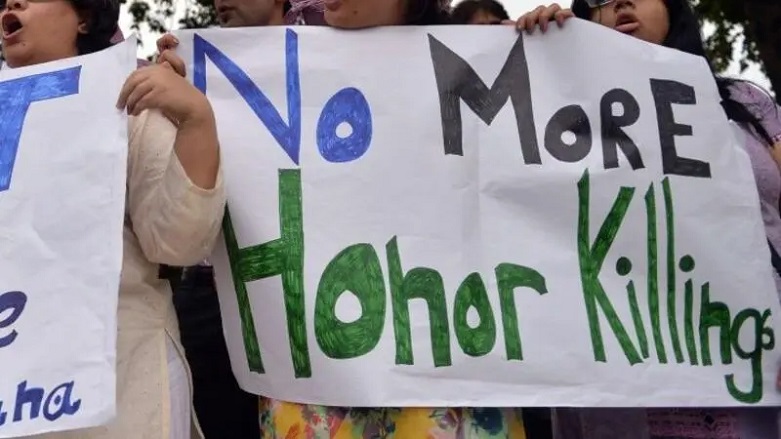
A protest in the southern Pakistani seaport city of Karachi condemns violence against women. (file photo)

The three territories of Pakistan, Khyber-Pakhtunkhwa (K-P), Swat and Azad Kashmir, were most excellently running their primary education system but it was destroyed by the earthquake of 2005. Taliban’s are also destroying the educational system of these territories. The parliamentarians of our country are also in favor of honor killing.

• In Pakistan the honor of a man rely on the behavior of her woman Women are always expected to behave modestly.
• Killing of the disobedient women is seen as a refinement of the family.
• Women are always expected to behave decently in our society because if they do any damaging act it will bring shame and dishonor to the male members of their family. Pakistan, women are scared to speak too loudly. These women live in fear each day of their lives because if they make one small mistake it
could mean their life. Yet, there are some people who are fighting for women’s rights, especially women’s education. They talk about honor killing in social television and support women in our community.

Deaths Of Women Put Spotlight On ‘Honor’ Killings In Pakistan

A spate of deaths of women in northwestern Pakistan has put the spotlight on so-called honor killings in the South Asian country. Each year, hundreds of women and girls are killed in Pakistan, often by relatives who say they are protecting the family’s honor. Despite stricter laws and public outrage in the Muslim-majority country, human rights groups say such killings continue. In the latest case, police said they have charged a man for murdering his 18-year-old daughter on the orders of a jirga, or tribal council, because she had appeared in a photo with unrelated men on social media.

Police said three others — the victim’s uncle and two cousins — were arrested on November 29 in Kolai-Palas, a remote district in Khyber Pakhtunkhwa Province. The victim has been identified as Reema Bibi, whom police say was shot dead by her father in the family home on November 24, soon after photos of her with a woman and two men appeared on social media.

Public images of women are considered taboo in deeply conservative rural areas of Pakistan. Police have said the photos of Bibi were manipulated.

Noor Mohammad, a police official in Kolai-Palas, told RFE/RL’s Radio Mashaal that the other woman and one of the two men in the photos were under police protection. The whereabouts of the other man in the images was unknown.

In another case, police said four people were killed on November 28 in the district of Dera Ismail Khan in Khyber Pakhtunkhwa.

Police said a man killed his wife following a marital dispute. In retaliation, the victim’s brother killed the husband’s parents and young sister on the same day, police said.

“This is very cruel and is done in the name of terrible local customs,” Mufti Hafizullah Sabri, a local religious leader, told Radio Mashaal. “This is the result of deep-seated ignorance.”

Khyber Pakhtunkhwa police have discovered that the five Kohistan girls seen cheering on male dancers in a 2011 video were killed. ─ File photo

Pakistani authorities have arrested four people who allegedly killed an 18-year-old woman in the purported name of honor after a picture of her sitting with a boyfriend went viral on social media, police said Thursday. Police said the photo had been doctored and posted on fake social media accounts, the BBC reported. The woman’s father and three other men were detained days after the slaying in Kohistan, a district of Khyber Pakhtunkhwa province bordering Afghanistan. Police said they were told about the killing on Nov. 24 and officers were still investigating.According to the local police chief, Masood Khan, the four arrested men apparently killed the woman on orders from village elders, who thought she had brought shame to her family by posing for pictures with a boy. Khan said the investigation determined that the photo of the couple that went viral had been edited by someone before it was shared on social media. He said investigators are trying to trace whoever edited and posted the image since it led to her killing.It was not immediately clear if the photo manipulation falsely made it look like the 18-year-old had sat with her boyfriend.
Recently, a 21-year old woman in Punjab was found raped and strangled to death by the man she had trusted to save her from an “honor” killing by her family. In early June, Saba Maqsood miraculously survived being shot by her relatives and dumped into a canal  in Hafizabad town in Pakistan’s Punjab province for trying to marry the man of her choosing against family wishes.A week earlier in Lahore, Farzana Iqbal was brutally beaten to death with bricks by up to two dozen relatives, including her father, for marrying the man she loved. Sadly, hundreds of women and girls are subject to “honor” killings in Pakistan every year.For many communities in Pakistan, women and girls are seen to embody family honor. A woman’s identity and her family’s sense of social respect and worth is measured by her acquiescence to family demands, such as marrying the man they choose for her.What made Iqbal’s death unique was the fact that the perpetrators chose to kill her so brazenly, outside one of the most respected state institutions: the Lahore High Court, in the second largest city in Pakistan and arguably its cultural capital. By all accounts, instead of protecting Iqbal and saving her life, the police stood by and watched the crime unfold.Most cases like this, however, receive scant attention by the public and the police, as they often happen in small villages or behind closed doors. In February, for example, Ayat Bibi was bludgeoned to death in a north Balochistan village on the orders of a local cleric after being accused by a male relative of having relations with a man named Daraz Khan, who was also killed. Ayat and Daraz’s final resting places are both unmarked graves. Those responsible for the killings have not been brought to justice.
US shares Kurdistan leaders' concerns about rise in 'honor killings'Farzana Iqbal’s killing, and the publicity that followed, shamed Pakistan’s prime minister and the Chief Justice of the Supreme Court into demanding investigations into the incident. Most of the key culprits were soon in jail, and the murder trial is expected to begin shortly. Some politicians and religious leaders have condemned the killing, a welcome move in a country where all too often violence against women is ignored or even justified based on religious or cultural values.

But what would have been the response if this crime had not been perpetrated in such a public and symbolic space and drawn global attention? As the spotlight fades away from this case, and Iqbal’s battered body settles in the ground like hundreds of others, are the authorities likely to lose interest in ensuring her killers are brought to justice and that the police are held to account for their failure to protect her?

Seeking justice is extremely problematic in Pakistan, as a wide legal loophole currently exists that allows perpetrators of “honor” killings to escape any punishment. Under Pakistani law in cases of murder, the victim’s family is allowed to pardon the perpetrators. The culprits are then free from prosecution and sentencing.

So-called honor killings are ubiquitous in several parts of South Asiaopens in a new tab and other corners of the world. It is difficult to determine exactly how many women fall victim to killings justified as the defense of family “honor,” but the number runs into the thousands worldwide.


Often, the most severe punishments for transgressions of “honor” or for bringing “shame” on a family are decreed by councils of tribal elders – in which women have no place. In Pakistan, the statistics vary from around 900 to just over 1,000 each year. But these figures represent only instances documented by human rights groups based on reports from the media or law enforcement authorities.Addressing these issues, whether in Pakistan, or anywhere else in the world, is challenging because the causes are complex. But like so many other social problems, positive change must start at home. Too often, the home is where the use of violence becomes normalized. It is where the citizen gets conditioned to believe that violence is an acceptable, particularly to excuse violence that is carried out to protect perceived social standing, national honor, or religious sentiments.Honor crimes fester in the dark privacy of the home. It is time to expose these abuses to the light of public scrutiny and the law. A number of states have outlawed honor killings and other forms of gender-based violence. But those laws require effective implementation, police and other law enforcement professionals must be trained on gender-based violence. And victims must be confident in the ability of the police and other authorities to assist them.The education system is also a key battleground, because it is one of the rare public spaces where young minds can be empowered to challenge gender stereotypes and made aware that violence in the home is unacceptable. Public figures, and especially men, must openly speak out: not only to condemn honor killings, but to acknowledge that these abuses are not random or sporadic incidents but a much wider problem.Empirical research in this area is limited, but there is ample anecdotal evidence that public exposure is the most effective way to address the issue, because it forces society to confront the reality that there is no honor in killing women and girls for choosing to live life on their own terms.

‘Harrowing Reminder’

Human rights group say the incidents are just the latest cases of honor killings in Pakistan, where women have been slain for eloping with men, committing adultery, or even appearing in online videos and photographs.

The Human Rights Commission of Pakistan (HRCP) documented at least 384 cases of such killings in 2022 alone, including 103 in Khyber Pakhtunkhwa.

The cases are a “harrowing reminder that violence against women remains deeply accepted in Pakistan,” Asad Iqbal Butt, the head of the HRCP, said in a November 29 statement.

A 2016 amendment to the criminal law in Pakistan defined “murder committed in the name of honor” as a specific crime with stiffer penalties than homicide, including the death penalty or life in imprisonment.

But rights groups say the stricter laws have failed to curb the number of killings.

“While repeated so-called ‘honor killings’ have resulted in legislative amendments and societal outrage in the country, they remain unabated,” Nadia Rahman of Amnesty International said in a November 30 statement. “It is not enough to arrest people after such attacks take place. The authorities must end impunity for violence and abolish so-called village and tribal councils that prescribe such horrific crimes.”

In 2019, Pakistan’s Supreme Court declared tribal councils illegal because they violated the constitution and Islamabad’s international commitments to protect human rights and end gender discrimination.

But Rahman said the Pakistani authorities have failed to “curb the extra-legal power of jirgas or tribal councils to run parallel legal systems,” in a move she said has perpetuated “patriarchal violence with impunity.”

‘Blood’ Money

Kainat Kakakhel, a Pakistani lawyer, said the amended law aimed at curbing honor killings is not being fully enforced.

Under the law, a person convicted of “murder committed in the name of honor” cannot be pardoned by the victim’s family, which is permitted under Islamic law.

“[But] often, the police reports in honor killing cases are registered as murder cases, which opens the door to reconciliation, which is a major flaw,” Kakakhel told Radio Mashaal.

Under Pakistani law, the Islamic concept of diyat, which allows a victim’s family to forgive a murderer in exchange for financial compensation, or so-called blood money, from the perpetrator’s family.

High-Profile Cases

In one of the most high-profile cases in Pakistan in recent years, a tribal council in Kolai-Palas in 2011 ordered the deaths of four men and two women after a homemade video appeared to show unrelated men and women fraternizing at a wedding.

In 2013, three of the men — all brothers — were killed by the family members of the two women, according to the police. A fourth brother, Afzal Kohistani, was killed in 2019 after leading a yearslong campaign against honor killings in Pakistan.

In 2017, a provincial court had overturned the murder convictions against the six men from the women’s families.

Qandeel Baloch is one of the most well-known victims of honor killings in Pakistan. (file photo)Qandeel Baloch is one of the most well-known
victims of honor killings in Pakistan.

In another prominent case, a man was convicted of murdering his celebrity sister in 2016.

Muhammad Waseem was found guilty of strangling to death Qandeel Baloch, a controversial social media star who was dubbed the Kim Kardashian of Pakistan.

Waseem had publicly said he had no remorse for killing his 26-year-old sister over her “intolerable” behavior, after she posted racy pictures of herself with a Muslim cleric.

Waseem, 38, was sentenced to life in prison. But in February 2022 — after spending six years in prison — he was freed after his mother pardoned him.

Disclaimer:
While we hope you find this content useful, it is only intended to serve as a starting point. Your next step is to speak with a qualified, licensed professional who can provide advice tailored to your individual circumstances. Nothing in this article, nor in any associated resources, should be construed as financial or legal advice. Furthermore, while we have made good faith efforts to ensure that the information presented was correct as of the date the content was prepared, we are unable to guarantee that it remains accurate today. Neither Sada-e-Watan (Melody Media Productions) nor its sponsoring partners make any warranties or representations as to the accuracy, applicability, completeness, or suitability for any particular purpose of the information contained herein. Sada-e-Watan (Melody Media Productions) and its sponsoring partners expressly disclaim any liability arising from the use or misuse of these materials and, by visiting this site, you agree to release Sada-e-Watan (Melody Media Productions)  and its sponsoring partners from any such liability. Do not rely upon the information provided in this content when making decisions regarding financial or legal matters without first consulting with a qualified, licensed professional. 
By Aqsa Naz Content Writer Honor Killing In Pakistan پاکستان میں غیرت و عزت  کے نام پر قتل पाकिस्तान में ऑनर किलिंग “To call it ‘Honor Killing’ is not honorable. It is inhumane and should be termed ‘Despotic Killing! In the name of honor, a sixteen-year-old girl was killed by her family because she was raped by her brother. He assaulted her several times and then threatened to kill her if she told anyone. When she discovered that she was pregnant she had to tell her family. After the family arranged an abortion, they married her off to a man fifty years her senior. When he divorced her six months later, her family murdered her. Unfolding the honour killing phenomenon in Pakistan An honor
Stop Honor Killing – There is not sin greater than killing a woman

Dr. Ayesha Khan
PhD (
Doctor of Philosophy
Global Citizen

STOP HONOR KILLING
غیرت و عزت کے نام پر قتل بند کرو
ऑनर किलिंग बंद करो

The United Nations estimates that 5,000 women are victims of honor killings every year. These women are killed in order to “cleanse family honor,” after an individual has brought perceived shame or dishonor to a family or community by violating social norms.

“Honor” killings defined as “the murder of a woman by a close family member or partner as a result of (suspected or alleged) shame being brought on a family by the action (a suspicion or allegation will be enough) of the woman”

Honor killings punish women for bringing “disgrace” upon their families, for example by refusing forced marriages, being the victim of rape, getting divorced, having sexual relationships, or engaging in adultery. Although honor killings are not a new phenomenon, they have been increasing in number in recent years.

A significant reason for this increase in honor killings is because women and girls are becoming more aware of their rights; for example, they are not accepting forced marriage and want to have the freedom to choose their future spouses, their education and jobs, and to be present in public life shoulder to shoulder with men.

Abolish laws that discriminate against women, which are the root cause of gender-based violence against women. Additionally, include laws that safeguard men’s and women’s equal rights to ensure that honor killings of women and girls are prohibited. The need to put an end to honor killings is urgent. If we do not act today, we will see more honor killings in the future… “Stop Honor Killings.”Honor killings ttkt. Here, women in New Delhi raise their voices against the deadly practice.

While honor killings occur in many places around the world, in Pakistan, the problem is particularly acute. Though 1,000 people are estimated to be victims of honor killings in the country every year, the true number is believed to be much higher. However, accurate statistics are hard to come by as honor killings are often misconstrued as other crimes, covered up, or simply not reported.

With the rates of honor killings on the rise in Pakistan, that’s why the activists urge the government should launch a strong crackdown against the perpetrators of such violence by implementing laws in their true spirit. It should also make new laws and amends the existing ones, keeping in view the grim.

The ruthless practice of honor killing is not only prevalent in Pakistan but the Pakistanis who live overseas also seem to follow this tradition, making sure they adopt everything they leave behind in their home country. There are so many horrifying stories of honor killings that Pakistani girls are subjected to and have to live with wounds of their family’s injustice on their hearts forever.


Sacrificing the life of a girl to save their honor has been an evil increasingly marring Pakistani households. The male members of a family prefer to kill a girl who is found eloping with a boy whom she wants to marry out of her choice.

In Pakistan, many women are not allowed freely to marry a person of their choice though the religion puts no strict restrictions on it.  Observer say that given the insular attitudes of most Pakistani parents deeply rooted cultural norms, a girl is forcefully married to someone as soon as she hits puberty or finds herself in a relationship. If she tries to refuse the proposal by protesting against it or leaves her home to save her life, she is found being humiliated to brutal death.

“Honor killings” persist in Pakistan. Almost always, the victim is a woman; the killer a man. The woman’s offense is invariably refusing to bend to the will of her family. She is a sister who falls in love with a man not of her family’s choosing. She is a daughter who refuses to agree to an arranged marriage, sometimes to a man old enough to be her father. She is a wife who can no longer stay in an abusive marriage and divorces her husband.

Addressing these issues, whether in Pakistan, or anywhere else in the world, is challenging because the causes are complex. But like so many other social problems, positive change must start at home. Too often, the home is where the use of violence becomes normalized. It is where the citizen gets conditioned to believe that violence is an acceptable, particularly to excuse violence that is carried out to protect perceived social standing, national honor, or religious sentiments.

Honor crimes fester in the dark privacy of the home. It is time to expose these abuses to the light of public scrutiny and the law. A number of states have outlawed honor killings and other forms of gender-based violence. But those laws require effective implementation, police and other law enforcement professionals must be trained on gender-based violence. And victims must be confident in the ability of the police and other authorities to assist them.

The education system is also a key battleground, because it is one of the rare public spaces where young minds can be empowered to challenge gender stereotypes and made aware that violence in the home is unacceptable. Public figures, and especially men, must openly speak out: not only to condemn honor killings, but to acknowledge that these abuses are not random or sporadic incidents but a much wider problem.

Honor killings are nothing more than a cold-blooded murders driven by a warped sense of tradition and misguided notions of pride. Honor killings are not honorable by God. They are driven by ignorance and ego and nothing more. The honor is… to love, protect and defend….There is not honor in murder… Stop Honor Killings.

There is no honor in honor killing. Women are the most essential part of our society and I believe in their empowerment, protection and emancipation so that they can equally contribute towards development and prosperity of our country.

Views on Honor Killings in Pakistan

Disclaimer:
While we hope you find this content useful, it is only intended to serve as a starting point. Your next step is to speak with a qualified, licensed professional who can provide advice tailored to your individual circumstances. Nothing in this article, nor in any associated resources, should be construed as financial or legal advice. Furthermore, while we have made good faith efforts to ensure that the information presented was correct as of the date the content was prepared, we are unable to guarantee that it remains accurate today. Neither Sada-e-Watan (Melody Media Productions) nor its sponsoring partners make any warranties or representations as to the accuracy, applicability, completeness, or suitability for any particular purpose of the information contained herein. Sada-e-Watan (Melody Media Productions) and its sponsoring partners expressly disclaim any liability arising from the use or misuse of these materials and, by visiting this site, you agree to release Sada-e-Watan (Melody Media Productions)  and its sponsoring partners from any such liability. Do not rely upon the information provided in this content when making decisions regarding financial or legal matters without first consulting with a qualified, licensed professional. 
Dr. Ayesha Khan PhD (Doctor of Philosophy Global Citizen STOP HONOR KILLING غیرت و عزت کے نام پر قتل بند کرو ऑनर किलिंग बंद करो The United Nations estimates that 5,000 women are victims of honor killings every year. These women are killed in order to “cleanse family honor,” after an individual has brought perceived shame or dishonor to a family or community by violating social norms. “Honor” killings defined as “the murder of a woman by a close family member or partner as a result of (suspected or alleged) shame being brought on a family by the action (a suspicion or allegation will be enough) of the woman” Honor killings punish women for bringing “disgrace” upon their families, for example by refusing forced marriages, being the

Disclaimer:
Sada-E-Watan provides news and opinion articles as a service to our readers. These articles and news items come from sources outside of our organization. Where possible, the author and the source are documented within each article. Statements and opinions expressed in these articles are solely those of the author (reporter/newspaper) or authors (reporters/newspapers) and may or may not be shared by the staff and management of Sada-E-Watan. Sada-E-Watan was created to provide one convenient central location where a user can quickly scan headlines from many news sources. The headlines listed on Sada-E-Watan pages are links to stories on the sites where these stories are located. The goal of Sada-E-Watan is to help readers access stories on web sites that they would normally not have time to view on a regular basis and to add value to the news source sites by mentioning their name on top, so readers can view these sites..

The Sada-E-Watan takes no responsibility for any loss or damage suffered as a result of using the linked websites or as a result of using the information published on any of the pages of the linked websites.

Whilst every effort is made to ensure downloadable content is free from viruses, Sada-E-Watan cannot accept any liability for damages resulting from virus infection. You should take adequate steps to ensure your virus check regularly when using any device.

If you have any questions or comments about Sada-E-Watan, please contact us at: radio@sada-e-watan.com