




















By Ayesha Khan
FSc (Faculty of Science)
University of Peshawar
Pakistani Girls Education Trapped By Honor,
Early Marriages And Deep-Rooted Gender Discrimination
پاکستانی لڑکیوں کی تعلیم, غیرت کے نام پر پابندیوں، کم عمری کی
شادیوں اور جِنسی اِمتیاز کی گہری جڑوں میں گھری ہوئی ہے۔
पाकिस्तान में लड़कियों की शिक्षा ‘सम्मान’,
कम उम्र में शादी और गहरे जेंडर भेदभाव में फंसी हुई है।
“I raise my voice – not so I can shout but so that those without a voice can be heard…. We cannot succeed when half of us are held back….The extremists are afraid of books and pens, the power of education frightens them. They are afraid of women.” Malala Yousafzai
“One child, one teacher, one book, one pen can change the world.” Malala Yousafzai
 Pakistan was described as “among the world’s worst performing countries in education,”
Education is considered as one of the best tools for the transformation of the society, still millions of girls in Pakistan are unable to pursue their education after primary level. In Pakistan, even if a number of girls want to learn and have a better future, the local customs, poverty, marriage at an early age, lack of
schools, and gender inequality hinder them from completing their education. There are high numbers of out-of-school children, and significant gender disparities in education, across the entire country, but some areas are much worse than others.
Deep-rooted patriarchal norms, early marriages, and strict concepts of family honor. According to the Pakistan Economic Survey 2025-2026, while the overall literacy rate has climbed slightly to 63%, a severe gender disparity persists: the male literacy rate stands at 73%, compared to just 54% for females. This means nearly half of all Pakistani women remain illiterate, heavily concentrated in rural areas where female literacy drops to a stark 44%.

Trapped by Honor
The trap of honor and mobility in several conservative rural locations in Pakistan, it is believed that the honor of a family is determined by the chastity of their female members. This leads to formidable obstacles: Lack of access to education for girls is part of a broader landscape of gender inequality in Pakistan. The country has one of Asia’s highest rates of maternal mortality. Violence against women and girls—including rape, so-called “honor” killings and violence, acid attacks, domestic violence, forced marriage and child marriage—is a serious problem, and government responses are inadequate. Pakistani activists estimate that there are about 1,000 to 2,000 honor killings every year. Twenty-one percent of females marry as children.
“I have already seen death, and I know that death is supporting me in my cause of education. Death does not want to kill me.” Malala Yousafzai 
The Invisible Wall at Adolescence:
Although there has been some increase in enrollment of girls in primary education, the figures plummet in secondary education as families remove their daughters from school to enforce their isolation (purdah).So that no other man will lay eyes on our daughters. They stop sending them to school name of some honor. Some families believe that girls cannot success through education. Girls cannot succeed. Some families believe that education a waste girl time. They believe that men are there to earn money. So, they give good education to men and teach girls how to be household responsibility so that
when they get married, they can handle their in-laws well.
Another Major Reason:
And the second biggest reason is that there is a huge shortage of money in Pakistan. The socio economic conditions of the people are very bad, so they cannot give their children a good education, nor are there any schools in their area. Colleges are too far away for them, and they don’t have enough money to give their children a better educational opportunity to boys and get them admitted to good colleges. They are afraid that they cannot sell their daughters to distant areas, lest our daughters take this wrong step or if something goes wrong with them, it will harm our honor. Absence of Safe Transport: The fact that there are no safe transit options leaves girls vulnerable to street harassment, thus parents decide to keep them indoors instead of letting them go to school.
“When women are educated, their countries become stronger and more prosperous.”
The Impact of Religion:
The patriarchal readings of religion are often used by village leaders or conservative clerics to cast shame on people that allow their daughters to study secular subjects. There has been a massive increase in the provision of religious education, ranging from formal madrasas to informal arrangements where children study the Quran in the house of a neighbor. Religious schools are often the only type of education available to poor families. They are not, however, an adequate replacement, as they generally do not teach non-religious subjects.
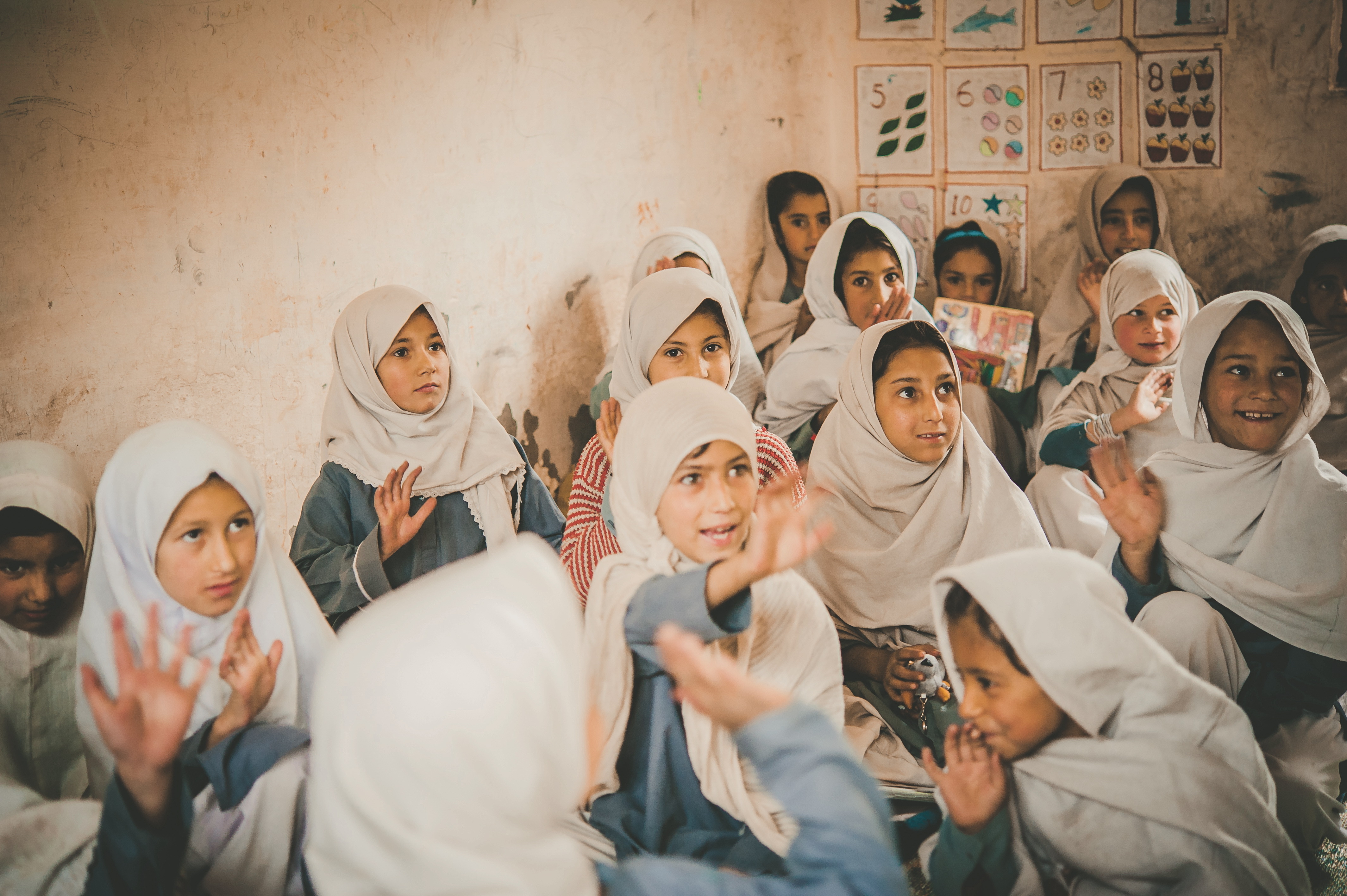
The Effects Of Child Marriage:
Child Marriage Begins a Girl’s Life long Journey towards Leaving Education Behind. Immediate School Dropouts: Girls typically leave school the moment they marry due to sudden domestic expectations and childbearing. Loss of Autonomy: Married underage girls lose decision-making power over their own lives, leaving family members or husbands in control of whether they continue learning.
Significant Statistics : Child marriage functions as a major barrier to girls’ education in Pakistan, permanently cutting short schooling and limiting future opportunities for millions of young women. According to UNICEF, 21% of Pakistani girls marry before the age of 18, and over half of married girls aged 15 to 19 have never attended school.
Child marriages end education for girls making them reliant on their in-laws, without education they could not handle financial matters and exposed to grave risk of domestic abuse and health problems. For many of these families who are struggling with finances, it is difficult for those girls to gain an education In many of these cultures, boys are considered to be the future earners for their families, while the girls are expected to marry and join another family This results in the boys being prioritized for education girls are often expected to contribute to the household in other ways, such as cooking and caring for younger children.
Queen Rania of Jordan: “I’ve always believed that when you educate a girl, you empower a nation.”
Marriage responsibilities now take precedence over a girl’s education and expectations. Lower Attainment: Early marriage directly correlates with lower literacy, reduced attendance, and poor academic performance. Health Risks: Child brides face high rates of early pregnancy, dangerous childbirth complications, and domestic abuse. Intergenerational Poverty: Lacking an education and personal autonomy, young mothers struggle to escape poverty, which negatively affects the health and nutrition of their own children.

High Cost of Education:
Poor families struggle to meet the costs of sending their children to school. Government schools are generally more affordable than private education, but they sometimes charge tuition, registration or exam fees, and they almost always require that students’ families foot the bill for associated costs. These include stationery, copies, uniforms, school bags, and shoes. Text books are sometimes provided for free at government schools, but sometimes families must pay for these as well.
The many poor families who cannot access a government school are left with options outside the government school system. The range of private schools, informal tuition centers, nongovernmental organization (NGO) schools, and madrasas creates a complex maze for parents and children to navigate. Many girls experience several—or all—of these forms of study without gaining any educational qualifications.
Video Credit: VOA/YouTube.
Poor Quality of Education:
Many families expressed frustration about the quality of education available to them. Some said it was so poor that there was no point sending children to school. In government schools, parents and students complained of teachers not showing up, overcrowding, and poor facilities. At private schools, particularly low-cost private schools, concerns related to teachers being badly educated and unqualified, and the instruction being patchy and unregulated. Teachers in both government and private schools pressure parents to pay for out-of-school tutoring, an additional expense. In both government and private schools, use of corporal punishment and abusive behavior by teachers was widely reported.
“Some girls cannot go to school because of the child labor and child trafficking.”
Corruption:
Corruption is a major issue in the government school system and exists in several forms. One of the most pervasive is nepotism or bribery in the recruitment of teachers and principals. Some people simply purchase teaching positions, and others obtain their jobs through political connections. When people obtain teaching positions illicitly, they may not be qualified or motivated to teach, and they may not be expected to. Especially in rural areas, some schools sit empty because corruption has redirected the teacher’s salary to someone who does not teach, according to education experts.
Poverty:
For many parents, the most fundamental barrier to sending their children to school is poverty. Even relatively low associated costs can put education out of reach for poor families, and there are many poor families in Pakistan. Out-of-School Children: Over 26 million children are out of school in Pakistan, and girls make up roughly 53% to 62% of this un-enrolled population. High Dropout Rates: Roughly 85% of girls drop out after primary school because families cannot afford further education or travel.
Gender Disparity: Girls from poor rural families are significantly less likely to attend school than boys in the same financial situation. Child Labor and Housework: Impoverished parents often keep girls home to do domestic chores, care for siblings, or work in home-based industries like sewing and embroidery to supplement family income. Distance and Travel Costs: Rural schools are often miles away, and families cannot pay for safe public or private transportation

Insecurity:
Many families and girls cited security as a barrier to girls studying. They described many types of insecurity, including sexual harassment, kidnapping, crime, conflict, and attacks on education. Some families said insecurity in their communities worsened in recent years, meaning younger children have less access to education than older siblings.
Families worry about busy roads; the large distance many girls must travel to school increases risks and fears. Many girls experienced sexual harassment on the way to school, and police demonstrate little willingness to help prevent harassment. Girls sometimes hesitate to complain about harassment out of fear they will be blamed, or their parents’ solution will be to take them out of school.
“Communities that give their daughters the same opportunities as their sons, they are more peaceful, they are more prosperous, they develop faster.”
Girls and families also fear kidnapping, another fear exacerbated by long journeys to school. This fear is heightened when girls are older and seen as being at greater risk of sexual assault. Attacks on education are disturbingly common in Pakistan. When violence happens in a school or in a neighborhood, it has long term consequences for girls’ education. Families across different parts of the country described incidents of violence in their communities that kept girls out of school for many years afterwards.

Shortage Of Girls Schools:
Some communities have primary schools but lack nearby middle and secondary schools for girls. The lack of female teachers is another issue. Parents in conservative area will to send their daughters to schools that have female teachers. So, a lack of female teachers will lead to fewer girls enrolling in those schools. Missing boundary walls, inadequate toilets, poor sanitation facilities and unsafe routes to school all pose a risk to adolescent girls, causing their parents to be reluctant to allow them to attend school. Creating an environment where girls can safely attend school will allow them to continue their education and improve their overall lives.
“Preventing girls from being educated is to steal their future.”
The government should invest in safe transportation, girls’ secondary schools, functional toilets, boundary walls and recruiting female teachers. Also, schools can work to create an environment that encourages girls to continue their education. Also, the existing laws that protect children from early marriage need to be implemented and the communities should be encouraged to embrace the long-term benefits of providing education to girls. Girls’ education is not only a matter of individual opportunity but also needed for the development of Pakistan. Educated girls are better equipped to participate in the economy, make informed decisions, support their families and contribute to their communities.

“All I want is education. And I am afraid of no one.” Malala Yousafzai
How to improve girls education in Pakistan:
Raise public spending: Allocate more of the national GDP to education to meet international benchmarks, moving past the current low levels. Gender-responsive budgeting: Ensure budgets specifically provide resources for girls’ latrines, boundary walls, and female teachers. Track spending: Use grassroots groups and NGO audits to stop corruption and make sure funds reach rural girls’ schools. Conditional cash transfers: Expand stipend programs for families who keep their teenage daughters enrolled in secondary school. Cover indirect costs: Provide free textbooks, uniforms, and school supplies to ease poverty burdens. Safe transportation: Fund bus services or travel allowances so girls in remote villages can safely reach middle and high schools. Close proximity schools: Build smaller, localized primary and secondary schools in rural and marginalized areas. Improve facilities: Equip all schools with clean water, electricity, and secure boundary walls. Safe spaces: Stop gender-based violence, bullying, and corporal punishment through active play-based learning and counseling. Hire local female teachers: Recruit and train staff from local communities to ease parental security concerns. Parental outreach: Host town halls and village meetings with mothers and community leaders to explain the long-term economic and health benefits of educating girls. Public-private partnerships: Work with local non-profits and private foundations to reach out-of-school children with flexible, localized learning models.
“If one man can destroy everything, why can’t one girl change it?”
Let’s inspire men and boys to take up the cause of advancing women’s and girls’ rights in our society. In order to empower and educate women and girls for a more just, inclusive, and forward-thinking future, let’s make a commitment to investing in girls and giving them a nurturing and supporting environment.
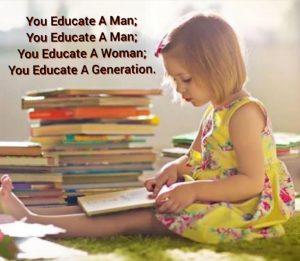
 “Educate a woman, and you educate a family, a generation, and the world.”
Disclaimer:
Sada-E-Watan provides news and opinion articles as a service to our readers. These articles and news items come from sources outside of our organization. Where possible, the author and the source are documented within each article. Statements and opinions expressed in these articles are solely those of the author (reporter/newspaper) or authors (reporters/newspapers) and may or may not be shared by the staff and management of Sada-E-Watan. Sada-E-Watan was created to provide one convenient central location where a user can quickly scan headlines from many news sources. The headlines listed on Sada-E-Watan pages are links to stories on the sites where these stories are located. The goal of Sada-E-Watan is to help readers access stories on web sites that they would normally not have time to view on a regular basis and to add value to the news source sites by mentioning their name on top, so readers can view these sites.
The Sada-E-Watan takes no responsibility for any loss or damage suffered as a result of using the linked websites or as a result of using the information published on any of the pages of the linked websites.
Whilst every effort is made to ensure downloadable content is free from viruses, Sada-E-Watan cannot accept any liability for damages resulting from virus infection. You should take adequate steps to ensure your virus check regularly when using any device. If you have any questions or comments about Sada-E-Watan, please contact us at: radio@sada-e-watan.com.