





















By Asma Ali
Master of Arts (MA)
English Literature
Religious Intolerance
مذہبی عدمِ برداشت
धार्मिक असहिष्णुता
“We believe that nations are stronger, and the lives of their people richer, when citizens have the freedom to choose, proclaim and exercise their religious identity. We have also learned that the denial of religious freedom or threats to it can cause fear, flight, fighting and even all-out war.”
“Religious tolerance is something we should all practice; however, there have been more persecution and atrocities committed in the name of religion and religious freedom than anything else.”
“Let us have love and more love; a love that melts all opposition, a love that conquers all foes, a love that sweeps away all barriers, a love that abundant in generosity, a large-heartedness, tolerance, forgiveness and noble striving, a love that triumph over all obstacle.”
Introduction:
Intolerance means the refusal to accept views, beliefs, opinions, or behaviors that are different from one’s own. It can lead to discrimination and prejudice against others. Religious Intolerance is looking down on a person or group because of their religion. Religious discrimination is a severe problem in Pakistan that affects not only Christians, Hindus, Sikhs, and Ahmadis, but also minorities from other sects, including the Shia, Ismailis, Bohra, and Hazara communities.
“Adopting an immoderate opinion on a specific issue in a religion is basically known as
religious intolerance”
Religious intolerance is one of the gravest problems of modern society in Pakistan and this
intolerance can be termed as extremism nowadays. In Muslim-majority nations, religion is an all-pervasive force informing and undergirding every part of life. Thus, religious extremism reaches every sphere of Pakistani society, from educational institutions and legal systems to social realities.

In the 1980s, General Zia al-Haqq led a program of Islamization that has profoundly shaped contemporary Pakistan. Educational curricula promoted an extreme version of Islam. Books were often overtly anti-Christian, and Christians regularly suffered humiliation from their teachers and fellow students. Religious extremism is also reflected in Pakistan’s anti-blasphemy laws, which prescribe life imprisonment for desecrating the Qur’an and a mandatory death sentence for insulting Muhammad. Many Christians have been falsely accused of blasphemy, arrested, and imprisoned or killed.
Freedom of religion in Pakistan is formerly guaranteed by the constitution of Pakistan for the individual of various religions and religious sects. Pakistan was founded in 1947 upon the concept of two nation theory, according to this theory minorities in Pakistan were to be given a fair deal but as the time passed Pakistan became a country dominated by Muslims (Sunnis) and thinking other minorities as inferior to them. When Pakistan came into being Muhammad Ali Jinnah declared that non-Muslims would be equal citizens in the new country.

The original constitution of Pakistan did not discriminate between Muslims and non-Muslims. After the incident of 9/11,the Pervez Musharraf government took steps to curtail religious intolerance against non-Muslims. Pakistan blasphemy laws are complicated and questionable both in their form and application. Pakistan’s Minority Federal Minister Shahbaz Bhatti, was murdered on 2nd March 2011 for his lifelong stand against the laws and the governor of Punjab Salman Taseer was killed by his own bodyguard on 4th January 2011 for standing up for a blasphemy defendant.

Salman Taseer
 Shahbaz Bhatti
In January 2023, The National Assembly of Pakistan voted to make the blasphemy laws more igniting alarm among minority communities and be used to further target minority communities.
Pakistani Christians played an important role in Pakistan’s independence. When they were in dire need of Sikh, Persian, and Christian minorities’ support, the Supreme Leader and other Muslim leaders promised them equal freedom and rights in the newly established government.
Thus Christians in Punjab and Sindh were fully active after 1945. Christians also supported the idea of a separate Muslim state.
Since Pakistan’s independence in 1947, until the mid-1970s, the Pakistani government was largely secular. But on 26 March 1971, Eastern Pakistan was declared the independent state of Bangladesh, and most of the Pakistani Hindus (who lived in Bangladesh) separated from Pakistan. Meanwhile, Pakistan’s transformation into a culturally integrated and increasingly Islamic state has turned Islam to the source of legislation and a cornerstone of national identity. The governments of Zulfiqar Ali Bhutto and Zia al-Haq therefore took greater Islamic law into account.
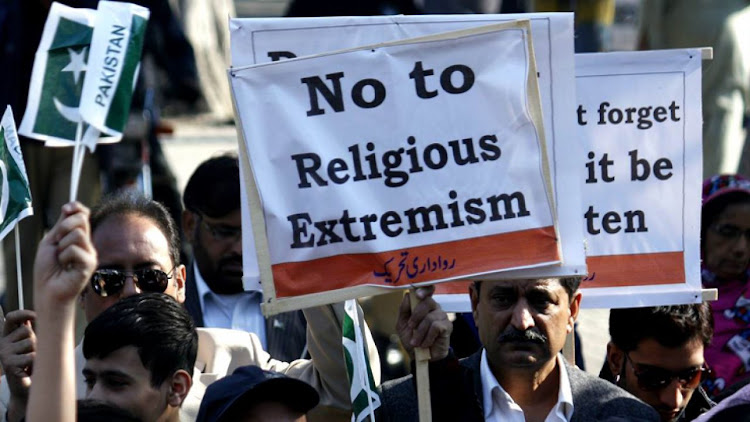
Prior to separation from India, Pakistan was a diverse religious and cultural community, but later tolerance to other religions and cultures was reduced. Now, Pakistan is a country where Muslim extremist groups and movements do not tolerate religious minorities. As a matter of fact, Christians have repeatedly been subjected to bloody attacks by extremists.
Pakistani society has become increasingly Islamized and homogenized. As some claim that before the separation, minorities made up 15 percent of the country’s population, but it is currently less than 4 percent.
Many Pakistani Christians believe that they do not have the socio-economic status and equal access to available opportunities, and indeed they are second-class, practically lower-income citizens, and have been denied to become President, Prime Minister, Senate Speaker, or National Assembly Speaker. They also claim that the Christians work in the poorest part of society. In the same vein, some Pakistani think tanks have included Pakistan in the list of a handful of countries that have placed religious minorities under the strongest pressure.
In Pakistan blasphemy allegations are often made on the basis of little or no evidence. Speaking in opposition to Islam is prohibited. Pakistan penal code mandates the death penalty or life in prison for anyone found guilty of insulting the religion or religious figures can be sentenced to death. While authorities have yet to carry out a death sentence for blasphemy, just the accusation can provoke riots.
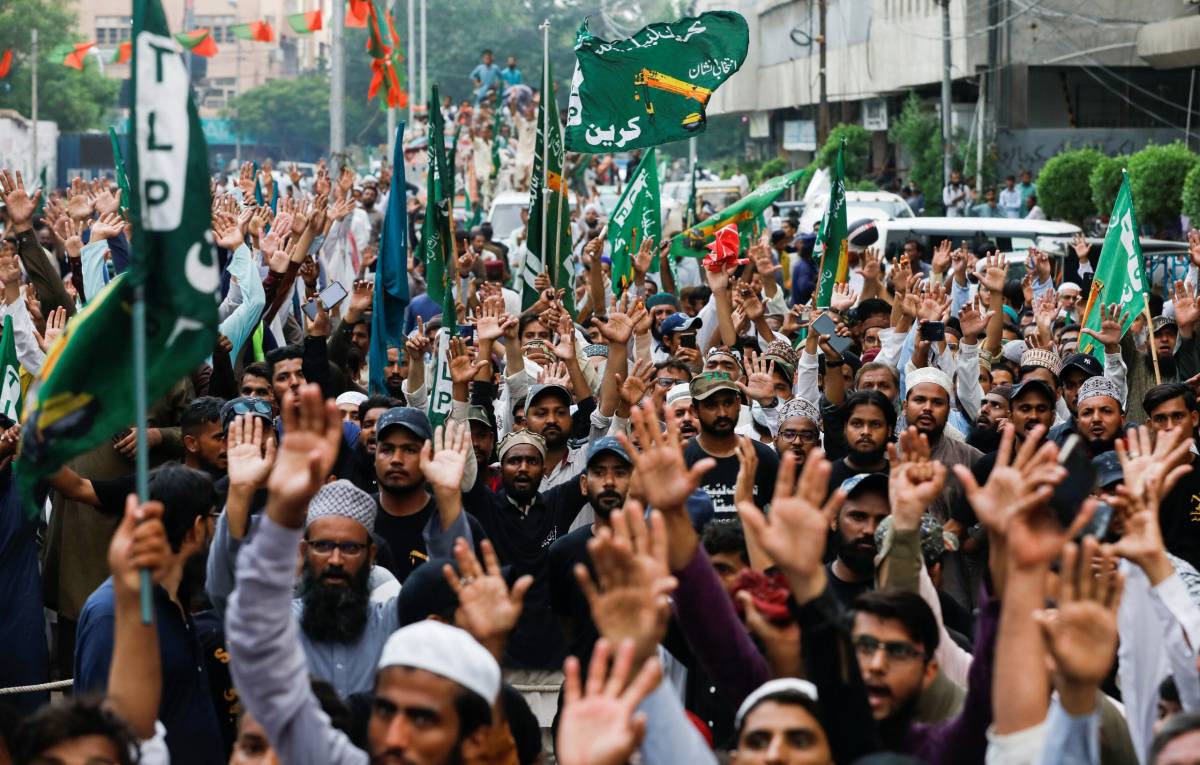
There is overwhelming evidence that the laws violate human rights and have encouraged the people to take the law into their own hands. Religious intolerance is deeply rooted in Pakistan’s socio-political fabric. The nation, although founded on principles of religious freedom and equality, has seen growing sectarian violence and discrimination against religious minorities. Sectarian violence particularly between Sunni and Shia Muslims has been a recurrent issue. Extremist groups like the Taliban , Lashkar e Jhangvi, Sipah e Sahaba and Tehreek e Labbaik have perpetrated attacks on Shia communities , leading to significant loss of life. The killing incidents create a climate of fear and insecurity among minorities. Since 2001, more than 2600 Shia Muslims have been killed in violent attacks. Shia, the largest minority group in Pakistan, has been the focus of the most sectarian violence. In 2022, a bombing attack inside a mosque in Peshawar had killed at least 56 people.
The Ahmadi community, a religious minority in Pakistan, is living in fear. They were declared
non-Muslims in 1974. They were banned to ask themselves Muslims and the resemblance of their worship place with the mosque was also banned. Not only Ahmadis are being attacked but almost 74 graves of Ahmadis are broken in Daska, the city of Punjab. Violent mob-attacks on minorities in Pakistan are not uncommon.
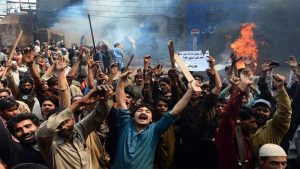
In August 2023 thousands of people attacked and burned 24 churches in Punjab. A Christian couple was killed over blasphemy in 2014 by an angry mob and their bodies were burned at the brick kiln where they worked in Kot Radha Kishan, a town in Punjab province.
In Faisalabad, on August 16, 2023, a Christian family was attacked by Muslim men because of accusation of blasphemy. A Christian man Nazir Masih, resident of Sargodha, was attacked in May this year and died because of injuries on June 3, 2024.
Forced conversion to Islam is also a violation of religious freedom and human rights. It is estimated that many people belonging to minorities such as Hindus, Christians and Sikhs are forcefully converted to Islam each year. Specifically, the females are forcefully married and converted to Islam against their will. A Hindu girl, Sohana Kumar Sharma, in Benazirabad district, in Sindh and a Sikh girl in Buner district, in KPK were forcefully converted to Islam although there is no concept of forced conversion in Islam. In Sindh, within 24 hours, two temples were demolished. At the time of partition there were 300 temples in Pakistan but now there are only three dozen that have managed to survive.

These are only a few instances of religious intolerance and extremism in Pakistan, the purpose is not to point out, but to highlight the problem and think about how to solve it. Illiteracy is one of the biggest causes of religious intolerance in Pakistan.
In Pakistan, lack of religious tolerance is due to the impact of educational curriculum, family
background, history and lack of knowledge about other religions. Pakistani public school textbooks related to non-Islamic faiths and non-Muslims teach bias, distrust, and inferiority. So it is deep rooted in the minds of Pakistani children that we cannot tolerate other religions.
Private religious schools called Madrassas are igniting discrimination by casting Hindus, Christians and other religious minorities in a negative light.
The Educational Curriculum should have the teachings of Religious Harmony to fulfil the purpose of unity. In a household, it’s our duty to teach our children that Religion is someone’s private matter and God has created all human beings equal. Over the last two decades religious political groups have grown into power so the religious minorities are targets of legal as well as social discrimination.
Through genuine dialogue between leaders of all faiths living in Pakistan, religious hatred can be removed. The message to non-Muslims is, “For you is your religion, and for me is my religion.” These
passages counsel tolerance and patience towards other faiths. Therefore, religious faith is a voluntary matter that individuals must choose freely and consciously not compulsively.”

In Pakistan, religious intolerance remains a pressing issue, manifesting in various forms that threaten social harmony and individual freedoms. Discrimination against religious minorities, including Christians, Hindus, and Ahmadis, is widespread, leading to systemic inequalities in education, employment, and social status. Blasphemy laws are frequently misused to target minorities, often resulting in violence instead of justice. The sectarian divide between Sunni and Shia Muslims further creates tensions, with targeted attacks and bombings occurring regularly. Despite constitutional guarantees of religious freedom, the reality on the ground often contradicts these ideals, as societal prejudices and legal ambiguities perpetuate a climate of fear for religious minorities. Addressing these issues requires not only legal reforms but also a concerted effort to promote tolerance, respect diversity, and safeguard the rights of all citizens regardless of their faith. “Laws alone cannot secure freedom of expression; in order that every man presents his views without penalty, there must be a spirit of tolerance in the entire population.”
 The founder of Pakistan, Quaid-i-Azam Muhammad Ali Jinnah, envisioned Pakistan to become a peaceful country where all citizens had the right to enjoy equality and were free to practice their faiths.
Conclusion:
It is disheartening to witness the pervasive religious intolerance in Pakistani society. The diversity of religious beliefs should enrich Pakistan’s cultural tapestry, not serve as a source of division and discord. It is imperative for us, as educated individuals, to advocate for tolerance and understanding among all religious communities. By fostering a climate of mutual respect and empathy, we can strive towards a Pakistan where every citizen, regardless of their religious affiliation, can live freely and contribute to our shared prosperity. Let us embrace our diversity as a strength and work together towards a more inclusive and harmonious future for our nation.
“We can never obtain peace in the outer world until we make peace with ourselves.”
If we want to see Pakistan compete in the modern world, we need to end religious differences. We should not be divided as Shia, Sunni, or Christian, but rather come together on one page and rise as a Pakistani nation. As Pakistanis, let’s put an end to religious intolerance and unite for a stronger, more harmonious nation.
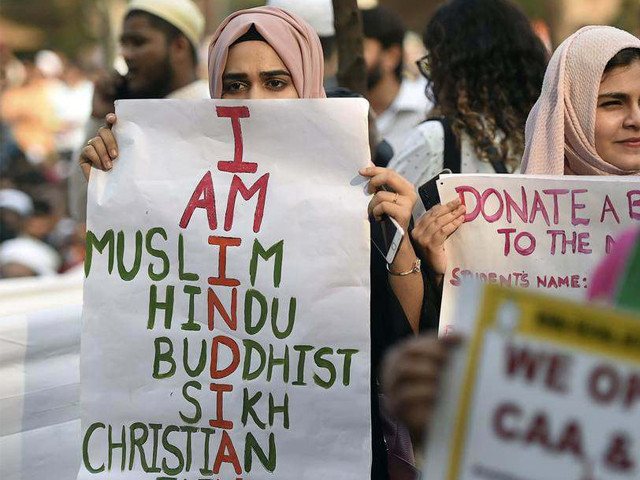
In conclusion, religious intolerance hinders Pakistan’s progress and unity. By embracing our shared identity as Pakistanis regardless of different faiths and creeds, we can overcome these divisions.
Ending religious intolerance is crucial for building a cohesive, prosperous nation where
everyone can thrive. The path to a united Pakistan, free from the shackles of religious intolerance, lies in the collective will of its people to embrace diversity and foster mutual respect. By celebrating the rich tapestry of beliefs and traditions that make up the nation, Pakistan can transform its challenges into strengths, proving that unity in diversity is not just an ideal but a tangible reality. It is time for Pakistanis to rise above sectarian divisions, to listen to the stories of their neighbors, and to stand together in the face of adversity. Let the spirit of tolerance and the principles upon which Pakistan was founded guide the nation towards a future where every citizen, regardless of their faith, can thrive in peace and harmony. In this shared vision, Pakistan’s true strength will be revealed, illuminating a path of prosperity, solidarity, and enduring unity for generations to come.
