
























By Maryam Shahjehan
Content Writer
By Asma Ali
Master of Arts (MA)
English Literature
Video: Express News
YouTube
Silent Wounds, Loud Cries:
Violence Against Women in Pakistan
خاموش ذخم، اُونچی چیخیں
پاکستان میں خواتین کے خلاف تشدد
खामोश ज़ख्म, तेज़ चीखें:
पाकिस्तान में महिलाओं के ख़िलाफ़ हिंसा
“With every slap unheard, every cry ignored, a wall is erected between justice and women in Pakistan.”
“The shame is not in a woman’s suffering; the shame is in a nation’s silence.”
“There is no place to feel safe if there is no justice from the home to the street.”
“The most deafening scream of a society that is deaf to the cries of women is Femicide.”
“There is no honor in bloodshed; there is no culture that flourishes on a graveyard of its daughters.”
 Introduction:
Violence against women can be defined as outlined by the United Nations Declaration on the Elimination of Violence against Women (1993):
“Violence against women is any act of gender-based violence that results in, or is likely to result in, physical, sexual, or psychological harm or suffering to women, including threats of such acts, coercion or arbitrary deprivation of liberty, whether occurring in public or private life”.
The term “violence against women” can also be defined as “the harassment or killing of women or girls by men due to hatred, contempt, pride, satisfaction, or a possession of females”.
The purposeful killing of women and girls because they are female, is not only one of the most extreme and visible forms of gendering against women, but it is also a significant and widespread problem across many societies and regions of the world. The manifestations of this violence can take the form of domestic violence, honor-based killings, or conflict- related sexual violence; all of which illustrate the fact that women experience higher vulnerability due to unequal gender relations and are often overrepresented in these forms of violence against women.
As we have seen, thousands of women continue to be killed due to gender-based violence, leaving families shattered and communities grieving and traumatized; despite global commitments to put an end to gender-based violence.
 There are different types of violence against women:
1- Physical violence includes beatings, burnings, acid attacks, slaps, killing, etc.
2- Sexual violence includes forced prostitution, marital rape, rape, and marital harassment.
3- Psychological violence includes humiliation, verbal abuse, isolation, and threats.
4- Economic violence like financial control, withholding funds, and failure to facilitate work or education.
5- Cultural violence includes dowry abuse, female genital mutilation, honor killings, and forced marriages.
There are various causes of violence against women:
Male dominance, toxic customs, and poor enforcement of the law are causes of violence against women in Pakistan. Many women are uneducated, depend on men financially, and do not know their rights. Child marriage, dowry abuse, and honor killing are prevalent acts. The victim blaming and tribal customs only intensify their suffering. Male drug addiction is also one of the major causes of violence.
In Pakistan’s bustling cities and sleepy villages, there is an invisible war occurring in the shadows, which costs innumerable lives, but lacks a battlefield. This battle is not with guns, but fists, silence, humiliation, and centuries of patriarchy. The victims are not soldiers, they are mothers, wives, and daughters, and their suffering is hidden in plain sight behind silence, legal indifference, and cultural rationalizations. Women are silenced every day, in public and behind closed doors, not just by their abusers, but by a system of complicity that remains indifferent to her cries. Violence against women does not happen by accident; it is systemic, a pattern, a pandemic, and a national failure, in a country that values honor over life, which uses shame against the survivor.
This article deals with the merciless consequences of gender-based violence in Pakistan. Not as crime acts, but as a symptom of something deeper and systemic. Stop asking, “Why didn’t she say something?” Now we should be asking “Why didn’t we listen?”.
Pakistan, a land of culture and proud people, is enduring a silent tragedy quickly burying its women; “violence against women” or honor killing if serious enough conjures images of someone sometimes killed for having born the wrong gender, but it is complicated in Pakistan. This is a story of women without the chance to lift a voice without it falling mute before it can be heard.
 Asma Rani (above) was shot dead near her home in Kohat in 2018
for refusing a marriage proposal; earlier this month, her killer was pardoned by her father
 Asma Rani (above) was shot dead near her home in Kohat in 2018
This article highlights the causes, effects, and immediate steps to diminish violence as a human rights violation.
Human Rights Watch pointed out that Pakistan has thousands of honor killings each and every year and thousands more are killed and made to disappear as suicides or accidents. Any woman who has dared to refuse forced marriage, continue an education, or simply attempt to take hold of female autonomy over her own life, is killed. However, such deaths cannot be classified, per international law, as gender violence. While it is bad enough that it is an epidemic culturally speaking, it is not exclusively cultural.
Pakistan is one of the most dangerous places for women, ranked the 4th most dangerous in a 2022 poll, and has several reports of violence against women, especially honor killings and intimate partner violence. According to the Human Rights Commission of Pakistan (HRCP), in recent years, there have been at least 400 honor killings documented annually, and the provinces of Punjab, Sindh, Khyber Pakhtunkhwa (KPK), and Balochistan saw cases of honor killings from all provinces. Arguably, rural areas are far more vulnerable to these crimes.
“A society which tolerates violence against women is one that values power more than peace, control more than compassion.”

Qisas and Diyat laws allow families of the victim to claim the qisas– and in ransom, the guilty party receives gain. Because the victim is typically a close relative, often of the same family, this effectively legalizes ‘honor killings’ without any consequences.
The Zina Hudood Ordinance of 1979 has a far-reaching impact on women’s safety in Pakistan as it indirectly fostered the killing of women in a culture of injustice and misogyny. The Zina ordinance blurred the lines between what is rape and if consensual relationships occurred outside of marriage, while making it impossible to criminally convict for rape (four male witnesses required). This caused women to hesitate to report assaults, as they would be exposing themselves to further violence.
The law also included women who could not demonstrate rape as criminals and put them at risk of severe punishment and social stigma. In many cases, the families related accusations of zina (adultery) with killings in the name of honor, a common type of violence.
“Boys are taught to be ‘strong’, aggressive while women are taught to compromise.”
As the scariest facts hide behind statistics, so does the voice of each and every victim. It would be impossible to relive every violation here, but I will try to highlight some incidents as an attempt to show the range of this cruelty, if not in totality, at least in part. And, perhaps if not many; at least, a few, can wake up to reality.

The murder of women can take many forms, often beginning with the most innocent and helpless victims. There is a particularly chilling example in the case of a 15-day-old baby girl. In Naushahro Feroze a father named Tayyab was arrested for the alleged crime of burying his 15-day-old daughter alive. The reports say that the infant was tied in a sack before she was buried. He confessed that he wanted to have a baby-boy and did not wish to waste his time and money on a useless girl.
In 1999, Samia Sarwar, a 28-year-old woman, was killed by her family on the pretext of resuming her divorce from her abusive husband. The family regarded her divorce as “dishonor” to them. She was murdered while on the premises of the office of her lawyer and human rights activist Hina Jilani, in a meeting which was arranged under the pretext of collecting her divorce papers.
In 2002, Mukhtaran Mai, a rural Pakistani woman, was gang-raped by four men, upon the orders of a tribal council, as punishment for a purported crime committed by her brother, in Meeranwala, Muzzaffar Garh district.
On July 16, 2016, 26-year-old social media influencer Qandeel Baloch was murdered by her brother because her behaviour was considered “intolerable” and he was “disgraced”. Her death signaled an important moment for the younger feminists, highlighting honour-based violence in Pakistan.
Noor Mukaddam, the 27-year-old daughter of a diplomat, was tortured, raped, and decapitated by her friend Zahir Jaffer on July 20, 2021 in Islamabad.
“The most dangerous place a woman can be, should not be her own home.”
In November 2024, in Daska in Sialkot District, a 30-year-old pregnant Zara Bibi was murdered by her in-laws. Her mother-in-law, Sughran Bibi, sister-in-law Yasmin, and Naveed, a relative, all participated in the murder of Zara. They strangled Zara, mutilated her body, and disposed of it in different parts of Daska. After four years of marriage to Qadeer Ahmed, Zara Bibi had a two-year-old son. In this case, the motivation was jealousy, with unfounded allegations of witchcraft against Zara.

The Shah Latif Town murder case in Karachi, November 2024, involves the incident of domestic violence, and an alleged “honor killing.” A 43-year-old woman named Parveen was brutally killed by her husband, Ali Hasan Sheikh, using a hammer and knife. The offence took place at their rented accommodation, where she had recently been living alone with her husband, after sending their five children off to their village Larkana days prior to the violent attack. The husband has already admitted to murdering his wife and claimed she was supposedly having an extramarital relationship.
Pakistani stage actress Nargis (Ghazala Idrees) has alleged that her husband, police inspector Majid Bashir, physically abused her. This abuse started after she denied him her property (including a farmhouse and gold) when he demanded it.
In a tragic case of gender-based violence, Safoora Taimur, a school teacher in Multan’s Gulzaib Colony, was shot and killed by her neighbor, Aun, after she rejected his marriage proposal. The police arrested Aun, who had been harassing her, within 24 hours of the incident.
In Noorshah village in Sahiwal, Mohammad Asif shot his two sisters, purportedly in a suspected “honor killing,” as he questioned their honorable lifestyle. Mohammad Asif, had previously killed his mother, but that crime was forgiven under the laws relating to family forgiveness, a system that often absolves offenders of such crimes in Pakistan.
On July 9, 2024, the Sania Zehra case in Multan involves barbaric murder, falsely labeled suicide. Forensic evidence demonstrated she had been tortured viciously with two broken ribs, crush injuries to her feet, and a severed tongue. Her husband, Ali Raza, is alleged to have killed Sania over issues related to property, parents involved. Authorities face outrage across Pakistan with demands for justice.
Local TV anchor Ayesha Jahanzeb suffered physical injuries at the hands of her husband, Haris Ali, during marital trouble in Lahore.
On July 15, 2025, veteran Pakistani TV anchor Jasmeen Manzoor shared graphic images on X (formerly Twitter) showing swelling and bruises on her face. She claimed these injuries were caused by her ex‑husband, who she described as a violent individual . A timestamped image suggests that the alleged assault occurred on June 4, 2025 .

On July 30, 2025 – Bodies of Sajid Masih and Sana were found a day earlier; murder case registered. Police registered an FIR regarding the murder of Sajid Masih and Sana, whose bullet-riddled bodies were found at Clifton beach on Monday. A major development has emerged in the case involving the discovery of the bodies of a young man and woman near China Port. DIG South Asad Raza revealed that a Karachi police team traveled to Gujranwala and arrested four individuals, including Waqas, the brother of the deceased girl, Sana Muhammad Asif. In a deeply troubling incident that has drawn national concern, the bodies of a young interfaith couple were discovered near the China Port area of Karachi. According to reports, the deceased have been identified as Sajid Masih, a Christian man, and Sana Asif Warraich, a Muslim woman. Both were originally from Budha Goraya village in Gujranwala, Punjab. This heartbreaking incident reflects the dangerous consequences of religious intolerance and deeply rooted societal prejudice. Interfaith couples, especially those involving minority communities, continue to face serious threats to their safety. The government must take decisive action to protect such vulnerable individuals.
On Aug 4, 2025 – A teenage girl was gunned down allegedly by her uncle on Monday in a ‘honor’ killing case in Khyber Pakhtunkhwa’s Battagram district. In the FIR, the suspect confessed that he had been a guest at his brother’s house for two days. “My brother went outside at night and told me to take care of the house,” the FIR quoted him as saying. He further said that he heard the sound of the gate of the house opening at around 2am, prompting him to wake up. “Using a flashlight, I saw that my niece was at the gate and going out with three people.” Upon seeing his niece leaving the house, he fired at the victim and the cartridge ran out, the FIR read. The suspect said that the victim’s mother gave him a pistol, adding, “After chasing them, I deliberately fired at Zahida Bibi out of honor.”
The firing killed the girl and injured one boy, while the other two people fled the scene, the FIR said. The police arrested the suspect and recovered the weapons used in the crime.
On September 24, 2024, in Harbanspura Lahore, Lady Constable Soman, 27, was killed by her jealous colleague Constable Farooq for marrying someone else.
In Karahi’s Sohrab Goth, in an “honor killing” Dr. Rafiq and son Abdullah shot Laraib and her friend Hassan adjacent to Sachal Police Station.
In June 2025, Sana Yousaf, a 17-year-old social media influencer, was ruthlessly gunned down in her home in Islamabad by 22-year-old Umar Hayat, a man she had rejected on multiple occasions. The assailant went into her house and shot her twice in front of her family, reportedly driven by feelings of obsession and rage over delivering her offer of friendship. He was arrested and confessed, but the legal processes are still incomplete. This case is another reminder of the obvious hostility and violence that many women face for not conforming to aspirations of desire and ownership.
In June 2025, tribal jirga held Bano Bibi, mother of five, and Ehsanullah, father of six, responsible for allegedly having an illegal relationship, leading to their brutal shooting in a remote area near Quetta, Balochistan. Forensic pathology reports confirmed that both Bano Bibi and Ehsanullah had numerous gunshot wounds. At least 14 suspects, which included family members and tribal elders, were arrested in connection with the case. The horrific details of this case demonstrated the continued use of illegal jirgas, continued prevalence of honor killings and the state’s inability to protect women from gender-based violence in tribal settings (nearly 50% of Pakistani women still experience violence of various types).
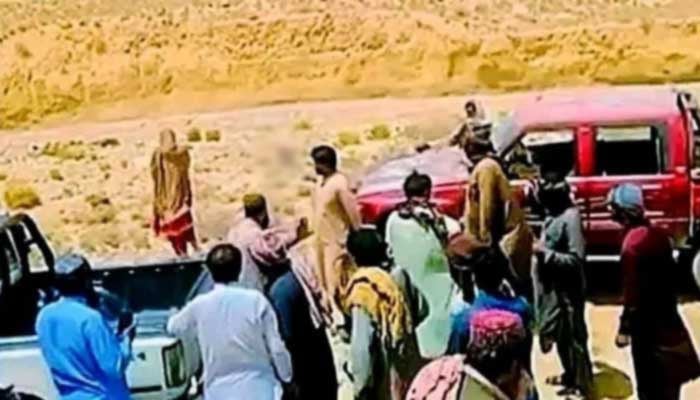 Screengrab of viral video shows tribal members carrying outz
“honour killing” at unknown location in Balochistan. — X
On July 30, 2025 – A couple, who contracted a court marriage seven years ago, was brutally murdered by gunmen in Balochistan’s Mastung district which is said to have been carried out by the woman’s brothers. This is the second shocking incident to come from Balochistan in less than a month. Previously, a video went viral, which showed a group of men forcing a couple out of a vehicle and leading them into a desert, where they were shot at close range following orders of a tribal jirga in Degari.
Meanwhile, the Mastung married couple, who were in their late 20s and originally residents of Panjgur, were shot dead at a local hotel in Lakpass area of Mastung, according to the Levies officials.
The victims were identified as Muhammad Shoaib and his wife, who contracted a love marriage seven years ago, which had later been accepted by the woman’s family following reconciliation.
In another horrific case from Lyari, Karachi, a 19 year old woman died as a result of extreme level sexual violence inflicted on her by her husband just weeks after their marriage. The violence sustained by the victim led to her hospitalization on July 4th 2025, with severe internal injuries, reportedly from barbarically severe marital rape and physical assault, including severe assault with a metal object. While medical professionals attempted to save her, the victim tragically died from her injuries on July 23rd, making her a beautiful reminder of the manifestations of violence many women are subjected to in their homes.

In July 2025, a new bride from Rawalpindi’s Pirwadhai area was alleged to have been murdered in the name of honour following a family jirga. Her husband had originally said that she died suspiciously, but investigations revealed signs of foul play. The case is a tragic reminder of how deeply embedded honour-based violence is in the fabric of Pakistan. This is often assisted by silence and community complicity.
Violence against women, specifically the gender-motivated murder of women, is something experienced by women all over the world, including the Pakistani diaspora. Some Pakistani men come from societies where they have stronger legal protections against violence, but since they still hold patriarchal beliefs and cultural norms regarding ‘honor’, they can be prone to violence against women. These cases show the need for some self-reflection, cultural change, and respect for fundamental human rights to protect the safety and dignity of women, wherever they are.
For example, in London, on April 29, 2023, Amin ur Rahman, 46, strangled his wife, 24-year-old Suma Begum, in front of their children, after being angered by her online relationship with Shaheen Mian in the UAE. Rahman filmed portions of the murder on a video call, before placing Suma’s body in the River Lea inside a suitcase, where it was found ten days later. Rahman was found guilty of murder and was sentenced to life imprisonment.
Sara Sharif, a 10-year-old child from Surrey in the UK, was found dead on August 10, 2023 with more than 70 injuries including fractures, burns, and signs that she endured abuse for an extended time. Her father Arfan Sharif, his partner Beinash Batool and brother Faisal Malik fled from the UK to Pakistan but were later arrested and returned to the UK. Arfan did admit to using more than what he described as “excessive” “discipline” tactics with Sara. Evidence of systematic abuse against Sara was uncovered, warning signs of abuse ignored by teachers and child protection services reinforced how easily situations like Sara’s can slip through the cracks.
These incidents point to the fact that both housewives and autonomous women are victims of violence , the only requirement appears to be a woman.

There are countless nameless women from rural Sindh, Balochistan, and Khyber Pakhtunkhwa provinces, who are regularly murdered, their deaths being labelled as ‘karo kari’ honour killing. These women, excluded from education and justice, while the inaccurate stories of many do not even exist, are erased from existence, to be forgotten about.
These examples demonstrate that women and girls suffer horrific violence, more commonly than not committed by their protectors—fathers, husbands, and other family members. Combined with a legal justice system that continues to fail at adequately addressing these cases, and the cogs and wheels of a patriarchal system that wants to reinforce itself, the cycle of violence will only continue on, across women, of all ages and backgrounds in Pakistan.
The Pakistani femicide can be traced back to the mythology of honor called for its people “ghairat”. As far as the context looks dreary, there is still a glimmer of hope with the engaged citizens of civil society and different organizations, working hard to eliminate gender based violence in Pakistan.
Aurat Foundation and Tehreek e Niswan are the names of some of the organizations.Women are using to come forward with their stories for change.
Some of the legal change that has happened in Pakistan has been the passing of the 2016 Anti-Honor Killing Bill, but implementation to date is still quite limited and many social/cultural barriers remain in the way of true reform.
In order to eliminate violence against women in Pakistan, there needs to be an intersectional action plan. With education and women standing to gain their independence, the most recent legal change which includes changing laws needs to be supplemented with a commitment to implementing the provisions of the new law so that those implicated in violations of the law can be punished.
An equally important aspect is to change the culture in the country too. We cannot change patriarchal culture and practices instantaneously but constant reinforcement of women’s rights and combating toxic honor-based behavior through small yet consistent motions may turn the tide.
The global civil society must stand with the women of Pakistan, and be supportive of every grassroots step and local effort going on in the country, and they need to compel the Government of Pakistan to not shirk its duty to protect women’s rights as part of gender specifically.
“No woman should fear for their lives for saying no, forging their own path or for simply existing in the realm they choose to”.
Conclusion:
This article reveals a grim reality where systemic injustices and entrenched patriarchal norms perpetuate violence against women. Breaking this cycle demands more than laws; it requires a cultural reckoning, collective action, and unwavering commitment to protect the lives and dignity of women.
Together, we face some grim realities due to systemic injustices and deep-set patriarchy that manifest as violence against women. In order to break this cycle we need more than legislation, it requires soul searching, collective action, and commitment to safeguard the life and dignity of women.
The violence against women in Pakistan is no longer just a crisis or an epidemic, but a demonstration of normalised oppression that continues to be exercised on its women. Each woman silenced creates a void, the unspoken account of a woman, the future of a woman not realised.
Change takes time; Guess what? The journey will only be legitimate when the voice, strength, potential of the oppressed and unheard is seen and heard: no one is made to disappear into the smoky back-alleys of discrimination.
“A nation rises when its women are safe; it crumbles when their lives can be taken with impunity.”
“True progress is safeguarding the rights and lives of women from the home to the streets and beyond.”
For all that violence to end in Pakistan, there must be effective laws in place to punish perpetrators of violence against women. It is important to teach a culture of respect for women and help annihilate negative traditions. We need to support women through education, developing means of employment and safety, especially since women’s lives matter and must be protected.
“A nation cannot rise if half of the population lives in fear of violence and death for just existing.”
Neither Sada-e-Watan (Melody Media Productions) nor its sponsoring partners make any warranties or representations as to the accuracy, applicability, completeness, or suitability for any particular purpose of the information contained herein. Sada-e-Watan (Melody Media Productions) and its sponsoring partners expressly disclaim any liability arising from the use or misuse of these materials and, by visiting this site, you agree to release Sada-e-Watan (Melody Media Productions) and its sponsoring partners from any such liability. Do not rely upon the information provided in this content when making decisions regarding financial or legal matters without first consulting with a qualified, licensed professional.