





















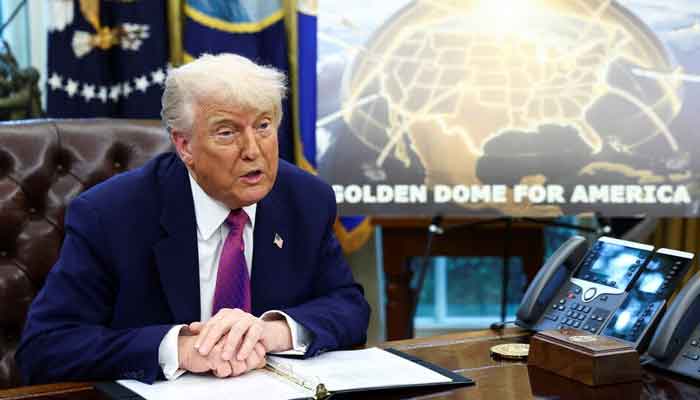
Courtesy: Geo News/Reuters
“I promised American people that I would build cutting edge missile defence shield to protect our homeland,” says Trump
US President Donald Trump picked a design for his Golden Dome missile defence system and named a leader of the ambitious $175 billion defence programme. Here are details on Golden Dome, where the idea comes from and how it will work.
How will it work?
The aim is for Golden Dome to leverage a network of hundreds of satellites circling the globe with sophisticated sensors and interceptors to knock out incoming enemy missiles after they lift off from countries like China, Iran, North Korea or Russia.
“I promised the American people that I would build a cutting-edge missile defence shield to protect our homeland from the threat of foreign missile attack,” Trump said when he made the announcement on Tuesday.
In April, the Pentagon asked defence contractors how they would design and build a network to knock out intercontinental ballistic missiles during the “boost phase” just after lift-off – the slow and predictable climb of an enemy missile through the Earth’s atmosphere. Existing defences target enemy missiles while they travel through space.
Once the missile has been detected, Golden Dome will either shoot it down before it enters space with an interceptor or a laser, or further along its path of travel in space with an existing missile defence system that uses land-based interceptors stationed in California and Alaska.
Beneath the space intercept layer, the system will have another defencive layer based in or around the US. This is something the Pentagon’s Missile Defence Agency looked into during the first Trump administration.
Is Golden Dome like Israel’s Iron Dome?
“We helped Israel with theirs, and [it] was very successful, and now we have technology that’s even far advanced from that,” Trump said, referring to Israel’s Iron Dome missile defence system.
The short-range Iron Dome air defence system was built to intercept the kinds of rockets fired by Hamas in Gaza.
Developed by Israel’s Rafael Advanced Defence Systems with US backing, it became operational in 2011. Each truck-towed unit fires radar-guided missiles to blow up short-range threats like rockets, mortars and drones in mid-air.
The system determines whether a rocket is on course to hit a populated area; if not, the rocket is ignored and allowed to land harmlessly.
Iron Dome was originally billed as providing city-sized coverage against rockets with ranges of between 4 and 70km (2.5 to 43 miles), but experts say this has since been expanded.
How is it similar to then-President Ronald Reagan’s Star Wars initiative?
“We will truly be completing the job that President Reagan started 40 years ago, forever ending the missile threat to the American homeland,” Trump said on Tuesday.
The idea of strapping rocket launchers, or lasers, to satellites so they can shoot down enemy intercontinental ballistic missiles is not new. It was part of the Star Wars initiative devised during the presidency of Ronald Reagan. But it represents a huge and expensive technological leap from current capabilities.
Reagan’s “Strategic Defence Initiative,” as it was called, was announced in 1983 as groundbreaking research into a national defence system that could make nuclear weapons obsolete.
The heart of the SDI programme was a plan to develop a space-based missile defence programme that could protect the US from a large-scale nuclear attack.
The proposal involved many layers of technology that would enable the United States to identify and destroy automatically a large number of incoming ballistic missiles as they were launched, as they flew, and as they approached their targets.
SDI failed because it was too expensive, too ambitious from a technology perspective, could not be easily tested and appeared to violate an existing anti-ballistic missile treaty.
Who will build Golden Dome?
Trump ally Elon Musk’s rocket and satellite company SpaceX has emerged as a frontrunner alongside software firm Palantir and drone maker Anduril to build key components of the system.
Many of the early systems are expected to come from existing production lines. Attendees at the White House press conference with Trump named L3Harris Technologies, Lockheed Martin and RTX Corp as potential contractors for the massive project.
L3 has invested $150 million in building out its new facility in Fort Wayne, Indiana, where it makes the Hypersonic and Ballistic Tracking Space Sensor Satellites that are part of a Pentagon effort to better detect and track hypersonic weapons with space-based sensors and could be adapted for Golden Dome.
But Golden Dome’s funding remains uncertain. Republican lawmakers have proposed a $25-billion initial investment for it as part of a broader $150-billion defence package, but this funding is tied to a contentious reconciliation bill that faces significant hurdles in Congress.