










USA

USA

INDIA

India

BANGLADESH

BANGLADESH

NEPAL

Nepal

FIJI

FIJI

PAKISTAN

Pakistan

Melody Media Productions

Excellence in Broadcasting!

Pervez Saleem

(Producer/Director)

Religious Intolerance

A Grave Failure of Justice: Christians In Pakistan Protesting Against Court Ruling

By Mishal Gill
Academic Excellence
Gold Medalist
Lahore, Pakistan

A Grave Failure of Justice:
Christians In Pakistan Protesting
Against Court Ruling

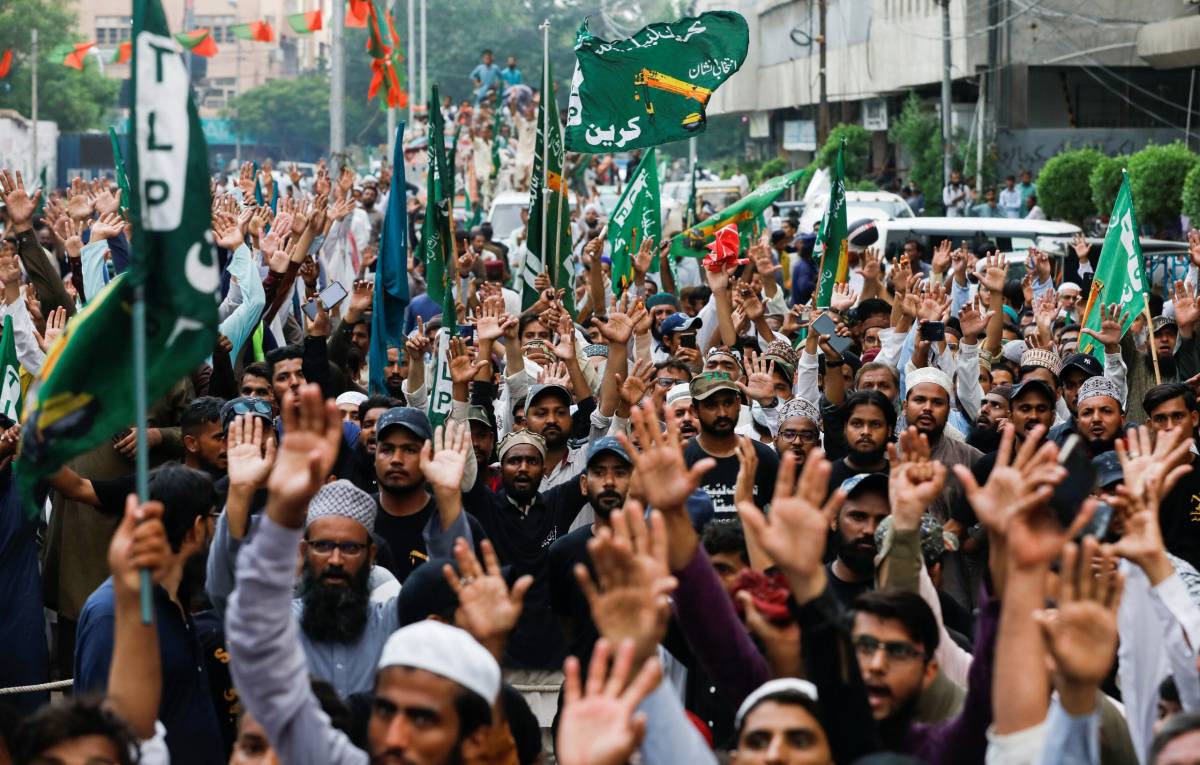
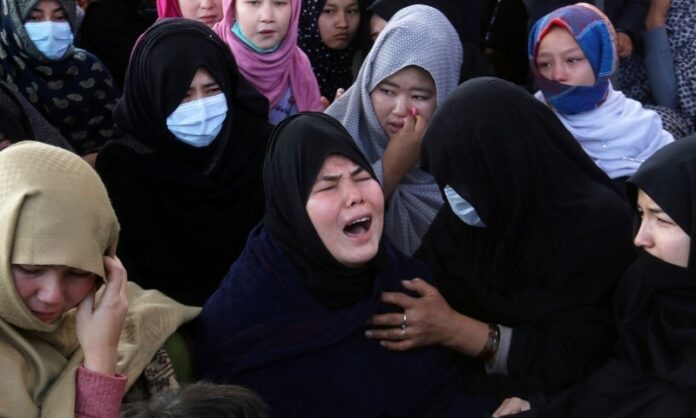
The decision by the High Court to uphold the marriage of a young Christian girl to a Muslim man after she disappeared and converted is an example of how for many Christians and Hindus in Pakistan, a recent court case has become much more than just a case. It has become a reflection of the fear of so many Christians and Hindus. Fear that when a minor daughter goes missing, her rights to her youth and her beliefs and those of her family will not be protected. This is why protests are taking place in cities such as Karachi, Lahore, Faisalabad, Multan, and elsewhere in Punjab. Church leaders, activists and ordinary citizens are demanding better protections for children from being forced into marriages and converting religions.

Christians in Pakistan are protesting a March 25, 2026, Federal Constitutional Court ruling that upheld the marriage of 13-year-old Christian girl Maria Shahbaz to a 30-year-old Muslim man who allegedly abducted her. The verdict has sparked national outcry, with protestors and church leaders decrying it as a grave failure of justice.

Archbishop Khalid Rehmat described the ruling as “profoundly disturbing” and “unacceptable,” stating that it “represents not only a grave failure of justice… but also sends a dangerous message that undermines the rule of law and weakens protections for vulnerable minority girls.” (OSV News, April 2026 — Full report on protests and church reaction)) 

Justice protects us from the strong. Justice is no longer a protective barrier at this point.

Catholic bishops and church leaders warned that the ruling “could set a dangerous precedent” and raised concerns that it undermines protections for minors and vulnerable communities. (Crux, April 4, 2026 — Pakistan bishops decry court ruling.

The high court based its decision on some interpretations of Islamic principles regarding marriages between Muslims and Christians. Specifically, the court said that since Christians are “Ahl al-Kitab” (the “People of the Book”), a Muslim man may legally marry a Christian woman. The court further stated that the girl’s conversion was proven simply by her declaring herself a Muslim. No formalities were necessary for her to convert. However, the court rejected documentation which proved that the girl was a member of a religious minority. Documentation included documents related to her delayed birth registration. The court used her own statements as proof that she had given her consent to marry. Many critics believe
that this line of reasoning ignores the basic issue here: Can a minor give their free consent to enter into a contract of marriage or choose a religion at all?

Credit Video: Express News/YouTube

The issue of religious minorities in Pakistan is an on-going problem in which the constitutional protection of religious freedom as defined within the 1973 Constitution is at odds with the real-life experiences of Christians and other non-Muslim. Despite legal protection against persecution, there exists a pervasive system of social and institutional discrimination facing religious minorities, due to extreme interpretations of Islamic law that are used to limit the freedoms of minority religions.

Archbishop Joseph Arshad stated, “This situation is deeply troubling,” adding that inconsistencies in applying laws protecting minors “undermine confidence in the justice system and raise grave concerns about the safety and dignity of vulnerable communities.” (Crux, April 2026 — Pakistan bishops decry court ruling)

An examination of statistics indicates a disturbing environment: between 2013 and 2019 alone, over 1,000 reports of violent acts and persecution occurred toward religious minorities (USCIRF / Human rights reports). Additionally, the use of the blasphemy laws has been used to persecute Christians, leading to arrest and mob violence creating a climate of fear among many religious minorities. For example, the unfortunate circumstances surrounding Asia Bibi, a Christian woman who was sentenced to death for allegedly committing blasphemy in 2009, highlighted the danger of using these types of legal frameworks and generated widespread protests and revealed how broken the justice system is in Pakistan.

Following the ruling, Ejaz Alam Augustine said it had caused “deep anguish and unrest” in the Christian community and described the issue as “a violation of the fundamental rights of minority citizens.” (Morning Star News, April 23, 2026 — Change sought to help kidnapped Christian girls)

Historically, Pakistan has struggled with issues related to its diversity in religious aspect. The country’s religious diversity is legally recognized through the 1973 Constitution which provides the right to free exercise of religion for all citizens, regardless of religion or creed. However, this provision has failed to become a reality in most cases. This is because of the increasing amount of power given to radical clerics who continually restrict this right. It is). Estimated that Christians represent approximately 1.6 percent of the population. Despite this small percentage, Christians experience some degree of systemic discrimination and violence. Hence, Christians can scarcely hope to retain any rights, if at all. The fact that Christians were lynched in 2017 for Blasphemy is merely a testament to the immediate need for safeguards for religious minorities in an exponentially growing atmosphere of hostility.
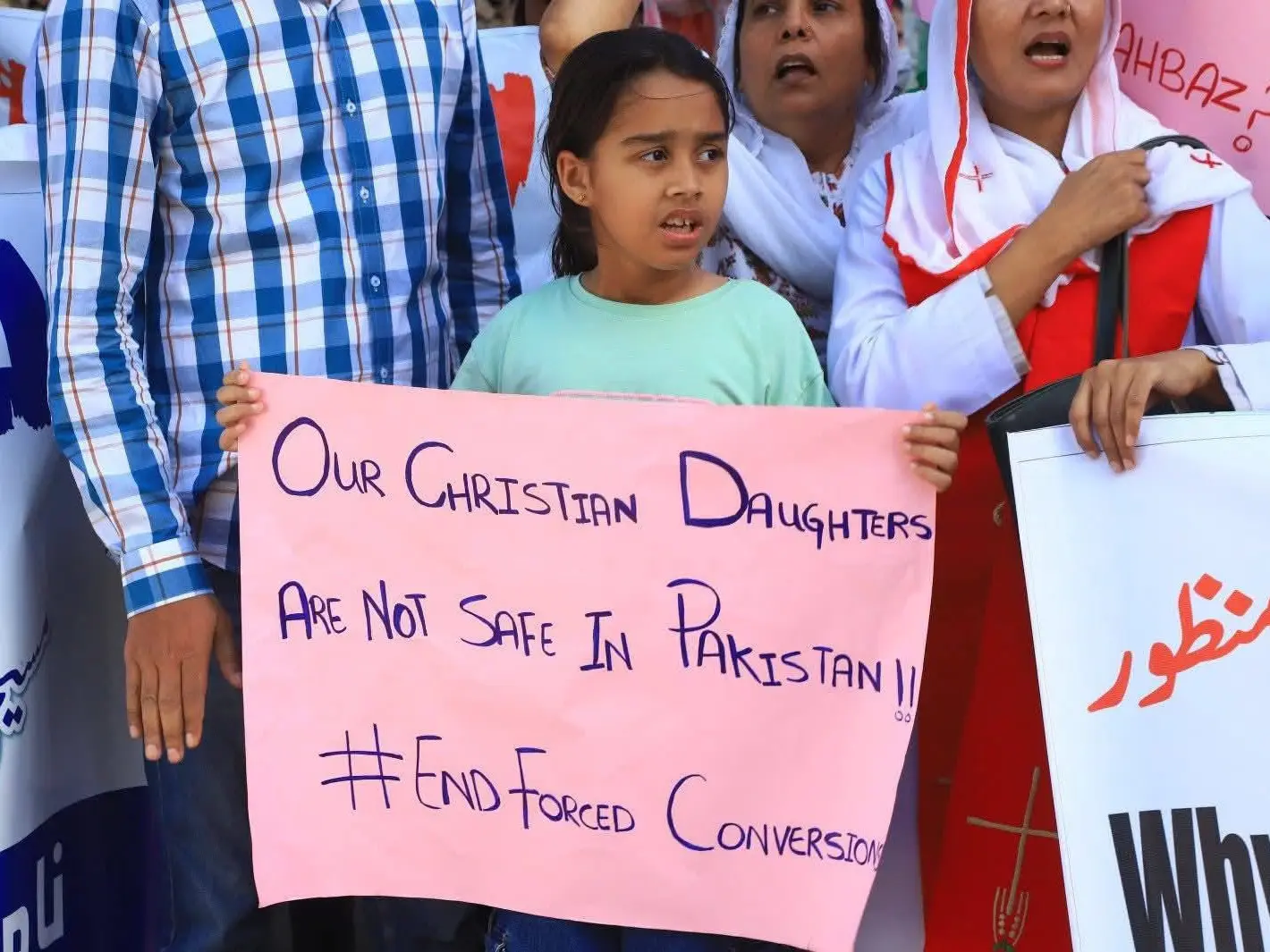
Why are Christians in Pakistan protesting against court ruling? Complete details here

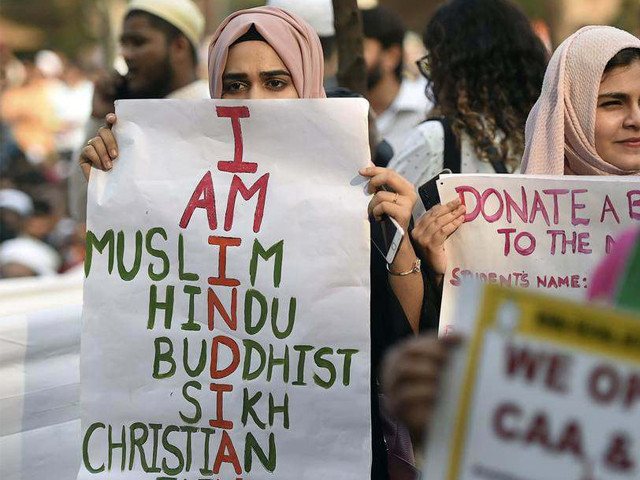
The Pakistani nation responded with protests on a large scale and an overwhelming sense of betrayal to the recent ruling of the courts. Christian protesters expressed that they were “extremely hurt” by the ruling and called for it to be reviewed, holding signs such as “Stop forced conversion” and “Child marriage is a crime” while demanding justice for minority girls. (Dawn, April 14, 2026 — Christian community protests ruling)

According to statistics, approximately 75 percent of the population believe that there is no consistency in the way that the legal system delivers justice – specifically in regard to cases dealing with members of religious minorities. Demonstrations broke out in major cities, where protesters called for accountability and reform of the legal system, further emphasizing the growing discontent with the current state of affairs. These demonstrations also represent part of a larger movement toward social change that was also seen in other movements including the demonstrations that followed the lynching of Mashal Khan in 2014, where almost 60 percent of the participants identified inadequate legal protections for minorities as one reason they participated in those demonstrations. The demonstrations related to the 2022 court rulings illustrate the extent of systemic problems associated with Pakistan’s political and social structure, highlighting the urgency needed for structural changes to occur to bridge the gap between what Pakistan’s judiciary does and what its citizenry expects from it.

Anthony Naveed warned that the ruling “has revealed serious deficiencies in the implementation of the laws protecting minors,” stressing the need for urgent legal reforms to protect children. He also added that “These laws have already been declared compatible with Islamic precepts by the Federal Constitutional Court in its rulings, underscoring the need for their strict application.”(Licas News, April 22, 2026 — Pakistan ruling raises alarm over child marriage loopholes)
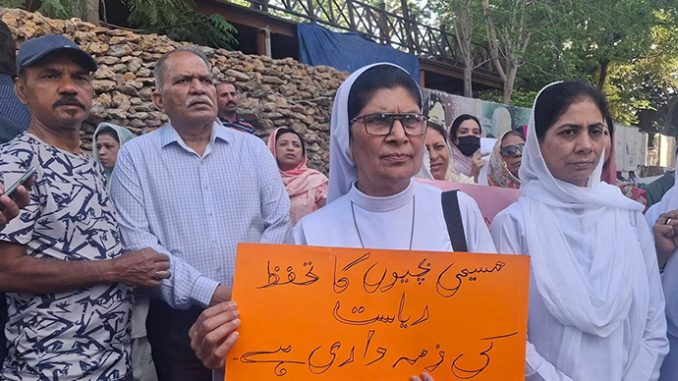
In Pakistan, the complexities involved with legal issues and society demonstrate a serious failure of justice that have generated massive civil unrest. The widespread rallies and pretests by Christians are indicative of a much broader struggle for religious freedom and equality. Based on the comparison of laws applied for religious minorities in India and Indonesia, laws are not always able to protect marginalized groups or offer protection to very little or no extent. Moreover, based on the examination of Pakistan’s legal past, there seems to be a recurring theme of corruption and incapability. Considering this, we should focus on developing and reforming the legal system. In the final analysis, this all leaves more unanswered questions, as for example the nature of safety and culpability where vulnerable
parties are concerned. It appears to illustrate an expanding gulf between legal pronouncements and their everyday human relevance. If significant and effective reforms are not made in such cases, public confidence in institutions could continue to erode over time and establish an increasing gap between communities and institutions, where trust and responsibility are no longer perceived as readily, if ever again, recoverable.

Disclaimer:

Sada-E-Watan provides news and opinion articles as a service to our readers. These articles and news items come from sources outside of our organization. Where possible, the author and the source are documented within each article. Statements and opinions expressed in these articles are solely those of the author (reporter/newspaper) or authors (reporters/newspapers) and may or may not be shared by the staff and management of Sada-E-Watan. Sada-E-Watan was created to provide one convenient central location where a user can quickly scan headlines from many news sources. The headlines listed on Sada-E-Watan pages are links to stories on the sites where these stories are located. The goal of Sada-E-Watan is to help readers access stories on web sites that they would normally not have time to view on a regular basis and to add value to the news source sites by mentioning their name on top, so readers can view these sites.

The Sada-E-Watan takes no responsibility for any loss or damage suffered as a result of using the linked websites or as a result of using the information published on any of the pages of the linked websites.
Whilst every effort is made to ensure downloadable content is free from viruses, Sada-E-Watan cannot accept any liability for damages resulting from virus infection. You should take adequate steps to ensure your virus check regularly when using any device. If you have any questions or comments about Sada-E-Watan, please contact us at: radio@sada-e-watan.com. 
By Mishal Gill Academic Excellence Gold Medalist Lahore, Pakistan A Grave Failure of Justice: Christians In Pakistan Protesting Against Court Ruling The decision by the High Court to uphold the marriage of a young Christian girl to a Muslim man after she disappeared and converted is an example of how for many Christians and Hindus in Pakistan, a recent court case has become much more than just a case. It has become a reflection of the fear of so many Christians and Hindus. Fear that when a minor daughter goes missing, her rights to her youth and her beliefs and those of her family will not be protected. This is why protests are taking place in cities such as Karachi, Lahore, Faisalabad, Multan, and elsewhere
‘Mazhab nahi, soch badlo’: Religious minorities seek end to forced conversions, intolerance

Courtesy: Dawn News
By |

“I have a problem with the use of the term ‘minority’. It only serves to otherise religious groups within the country and reinforce existing divides. We are all equal citizens of Pakistan.”

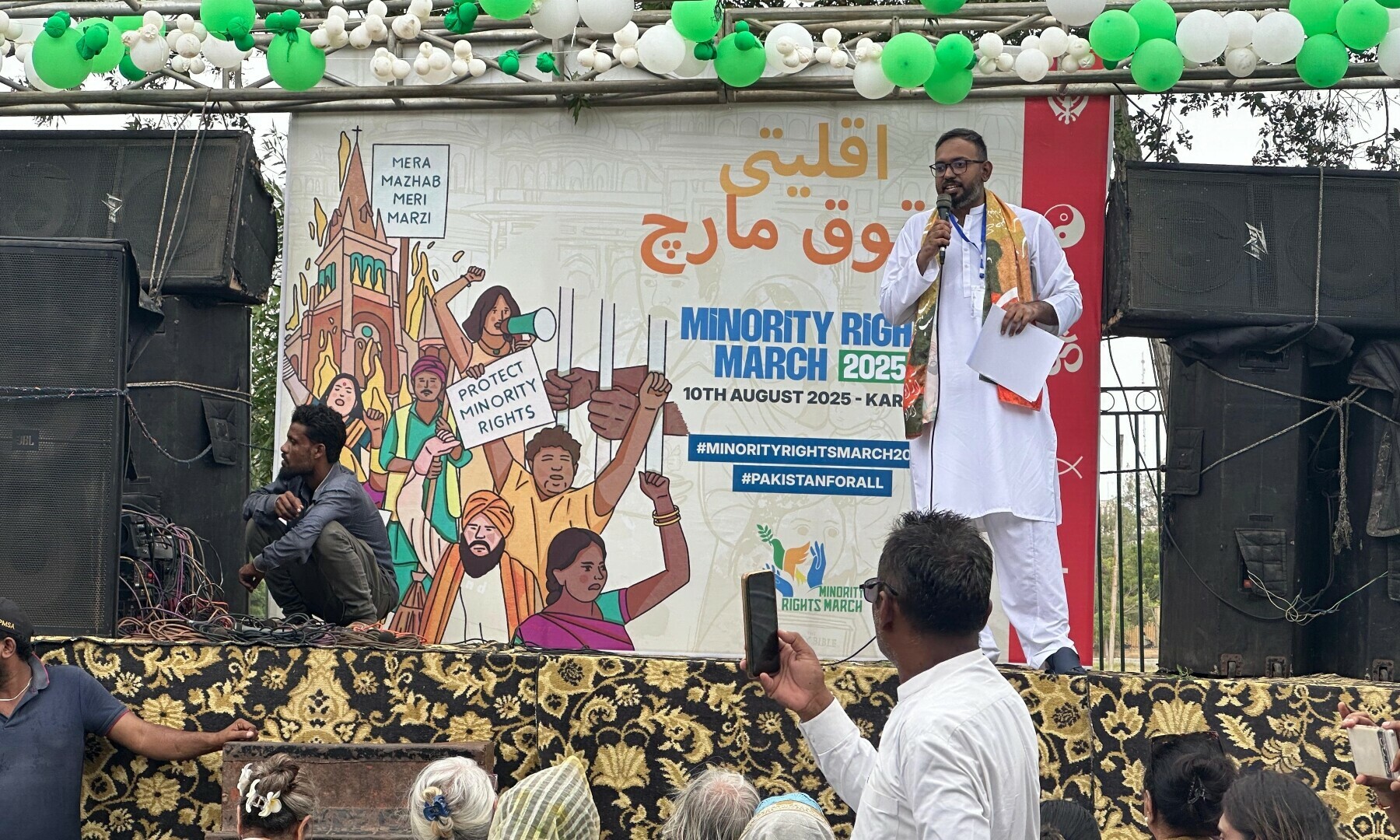
Christians like Pastor Daniel were among hundreds gathered at Karachi’s YMCA on Sunday for the Minority Rights March, which, ironically, was celebrated a day earlier since “minorities wouldn’t get a day off to celebrate it”.

Jinnah’s oft-quoted speech of Pakistani citizens being free to go to temples and places of worship remains relegated to the history textbooks since the lived realities for religious minorities across Pakistan are far from that freedom once promised.

“Christians like me aren’t allowed to preach their religion, and seldom can we practice it without the fear of the supposed majority,” said Daniel of Karachi’s Philadelphia Pentecostal Church.

Jinnah’s speech and his very upbringing were woven through the day’s itinerary. The speakers emphasised that his early education was at schools founded by religious minorities, to whom these schools now remain largely inaccessible.

Sunday’s march centred around two main demands: the denationalisation of educational institutions, and an end to forced conversions.

“The biggest discrimination against the Christian community and minority communities in general is that the institutions we built, the institutions that equipped Jinnah to become Quaid of the country, have now been captured under elitist policies and are inaccessible to the general minority population,” Luke Victor, an organiser at the march, told Dawn.com.
 Organiser Luke Victor addresses the crowd at the Minority March at the YMCA ground in Karachi, on August 10, 2025. — Photo by Shifa Organiser Luke Victor addresses the crowd at the Minority March at the YMCA ground in Karachi,
on August 10, 2025.— Photo by Shifa

Victor explained that the denationalisation policy has been in place for the past 40 years, but educational institutions still haven’t been returned to the church administration.

“We have a right under Article 22 to manage our own institutions, but the nationalisation policy is ultra vires of that,” Victor explained. Article 22 of the Constitution outlines “safeguards as to educational institutions in respect of religion”.

“It’s sort of a robbery of our heritage, of our educational institutions.”

Other speakers emphasised how former premier Benazir Bhutto was empowered by her alma mater, Karachi Grammar School — founded by the city’s first chaplain, Reverend Henry Brereton — but it hardly has any Christian students today.

“Systemic discrimination and biased policies have kept minorities away from institutions they once founded and thrived in. They now face a state-created cycle of educational exclusion,” a post on the Minority Rights March’s official X account said.

On the other hand, Christian-founded public schools like the YMCA lie vacant and misused after being brought under government control as part of the nationalisation policy.

Several points made at the march were amplified speeches of a robust social media campaign that the Minority Rights March team had begun ahead of the event. #EducationForAll, #GiveBackOurInstitutions, #StopForcedConversions and #MeraMazhabMeriMarzi were just some of the hashtags across the team’s social media, which were spotted on posters too.

“The state has stolen our educational institutions from us,” one speaker chanted to applause from a colourful sea of participants dressed in quintessentially Sindhi chunri prints, munching on papad and bhel sold by vendors who followed the crowd as they marched to the Arts Council Chowk. The crowd was a microcosm of what minority communities in Pakistan tend to look like: intergenerational, close-knit, small but mighty.

End to forced conversions

One of the many slogans reverberating through the crowd of 500-something people was ‘mazhab nahi, soch badlo’ (change your mindset, not religion), which called for an end to forced conversions of Hindu girls.
 An attendee Minority Rights March sits outside the YMCA holding a placard saying ‘Mazhab nahi, soch badlo’ on August 10, 2025. — Photo by Anushe Engineer An attendee Minority Rights March sits outside the YMCA holding a placard saying ‘Mazhab nahi, soch badlo’
on August 10, 2025. — Photo by Anushe Engineer

“If you can’t get a driver’s licence or own a gun before the age of 18, then why are forced conversions allowed before that age?” asked one speaker who runs a private shelter for young minority girls who were forcibly converted.

The state’s failure in this case is two-pronged; on the one hand, it fails to protect religious minorities from being forcibly converted. On the other hand, the police refuse to recover those who have been abducted and converted, claiming the girls have now embraced Islam and the parents must stop seeking their recovery.

According to a study by the Human Rights Commission of Pakistan, Sindh, a province that is host to the largest Hindu population in the country, has seen a mass exodus of Hindus towards India.

“We have a total of 11 demands today, the foremost being an end to forced conversion of Hindu girls,” said organiser Rampal Singh, who donned a sea-green turban and white kurta shalwar, standing in solidarity with his Hindu brethren.

“This is not a protest but a celebration for us,” Singh proclaimed, vowing to stand with his Muslim brothers on August 14 as “they are standing with us today”.

“I am a son of this soil, and all we are asking today is that, please hear us out and our issues.”

Suhani Naveej, of the Jaguti Foundation, detailed her work on the issue of forced conversion. “Many Hindu parents are now refusing to get their daughters’ CNIC cards made lest it be used as evidence in a court, declaring her a legal adult if she is ever abducted and forcibly converted.”

Naveej believed that the state’s apathy towards the plight of Hindu girls often leaves them vulnerable to social and educational inequalities.

“The lack of a CNIC card severely impacts the future prospects of the girls, barring them from accessing education and healthcare, among other basic facilities,” Naveej said.
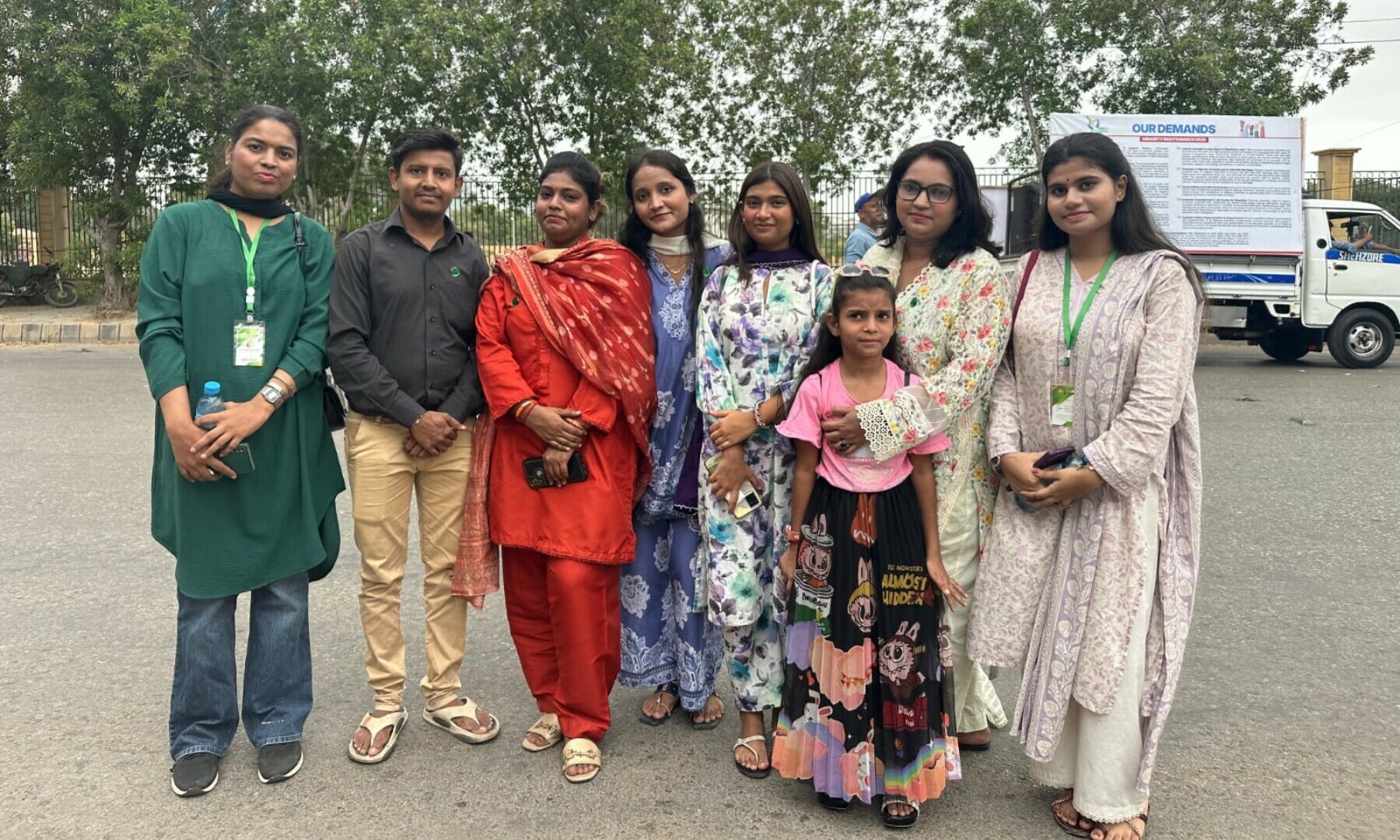
 Activist Suhani Naveej and Sanjana Kumar pictured with their group from Jugati Foundation at the Minority Rights March 2025 in Karachi on August 10, 2025. — Photo by Shifa Activist Suhani Naveej and Sanjana Kumar pictured with their group from Jugati Foundation at the Minority Rights March 2025 in Karachi on August 10, 2025. — Photo by Shifa
Still, the activist remained hopeful. Through her work, she aims to rebuild the Hindu community’s trust in state institutions. She has repeatedly called on the state to support her efforts in bridging the divide that has taken root only due to the state’s negligence.

While expressing despair at the state of forced conversions, activist and organiser Najma Maheshwari said: “Today is supposed to be a day of celebration for us, but instead, we are forced to protest for our basic rights, and for our daughters to not be taken away.”

Voluntary migration also has its roots in religious discontent. Several nurses belonging to religious minorities flee the country due to workplace harassment, which Pastor Naomi Bashir urged the government to end, as well as address the severe shortage of nurses in Pakistan.

‘Apna kachra khud uthao’

There was an almost palpable distaste from the crowd when speakers addressed the synonymity of sanitary workers with religious minorities, particularly Christians and Hindus, who are often referred to as “churra” and “bhangi” (derogatory terms used for cleaners).

“We always see that job listings for sanitary work or Khakrob, exclusively ask for non-Muslims. Such actions constitute and promote systemic exclusion against religious communities, pushing them towards the margins,” Jagruti Foundation’s co-founder Sanjana Kumar told Dawn.com.

Jagruti Foundation is an initiative which aims to promote education in underserved communities.

Kumar, among many others at the march, questioned the discrimination, asking if cleanliness is “half of faith, then why does the responsibility of it fall solely on religious minorities?”

“Is that why we voted to be a part of Pakistan? So we could pick up trash?” one organiser asked as she spurred the crowd to chants of “shame, shame”.
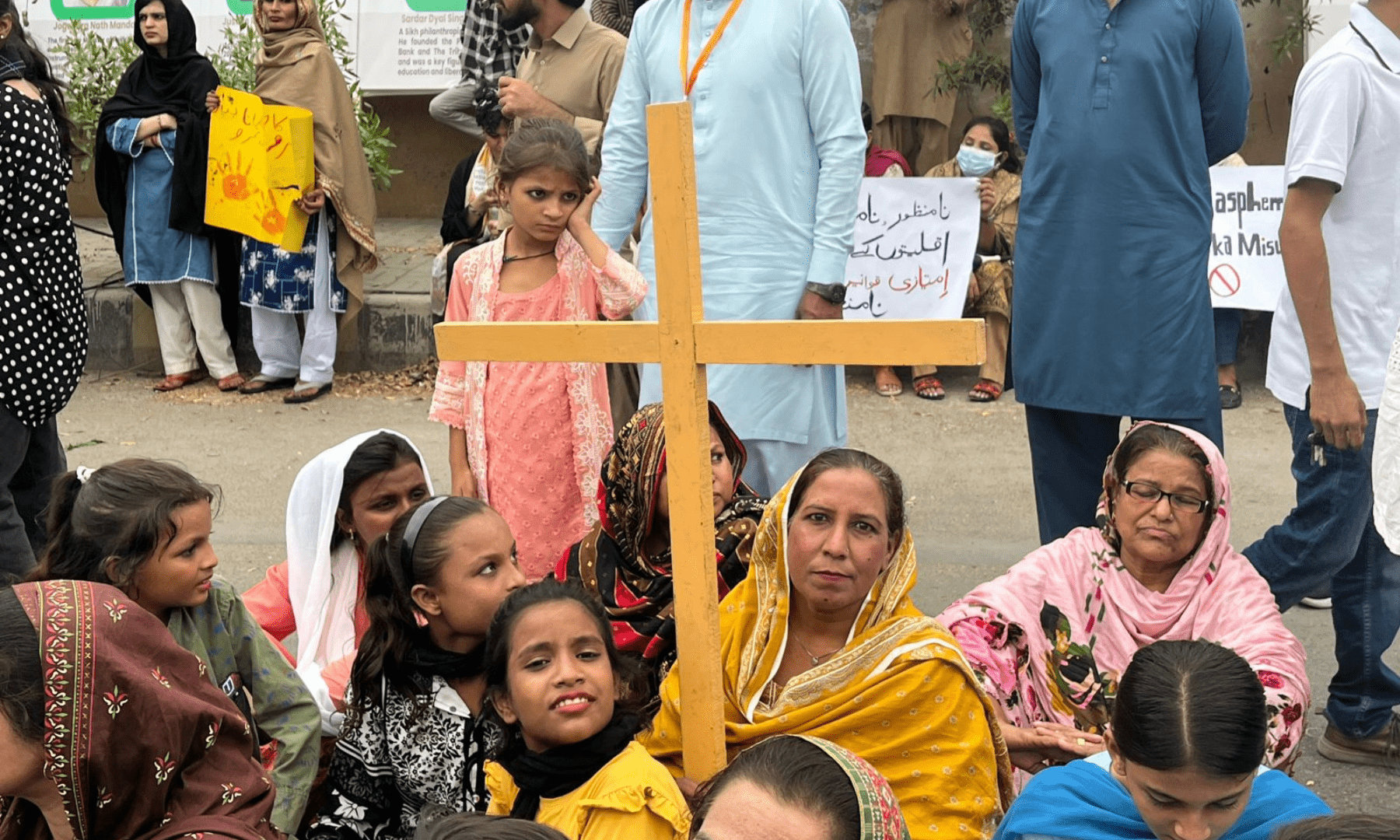
 A woman holds up a wooden cross as she sits outside the YMCA at the Minority Rights March in Karachi on August 10, 2025. — Photo by Anushe Engineer A woman holds up a wooden cross as she sits outside the YMCA at the Minority Rights March in Karachi
on August 10, 2025. — Photo by Anushe Engineer

The day’s doom and gloom was replaced by crowds dancing and swaying to a harmonium player singing Damadam Mast Qalandar as the sun broke through a cloudy sky that shielded the crowd from otherwise unbearable heat.

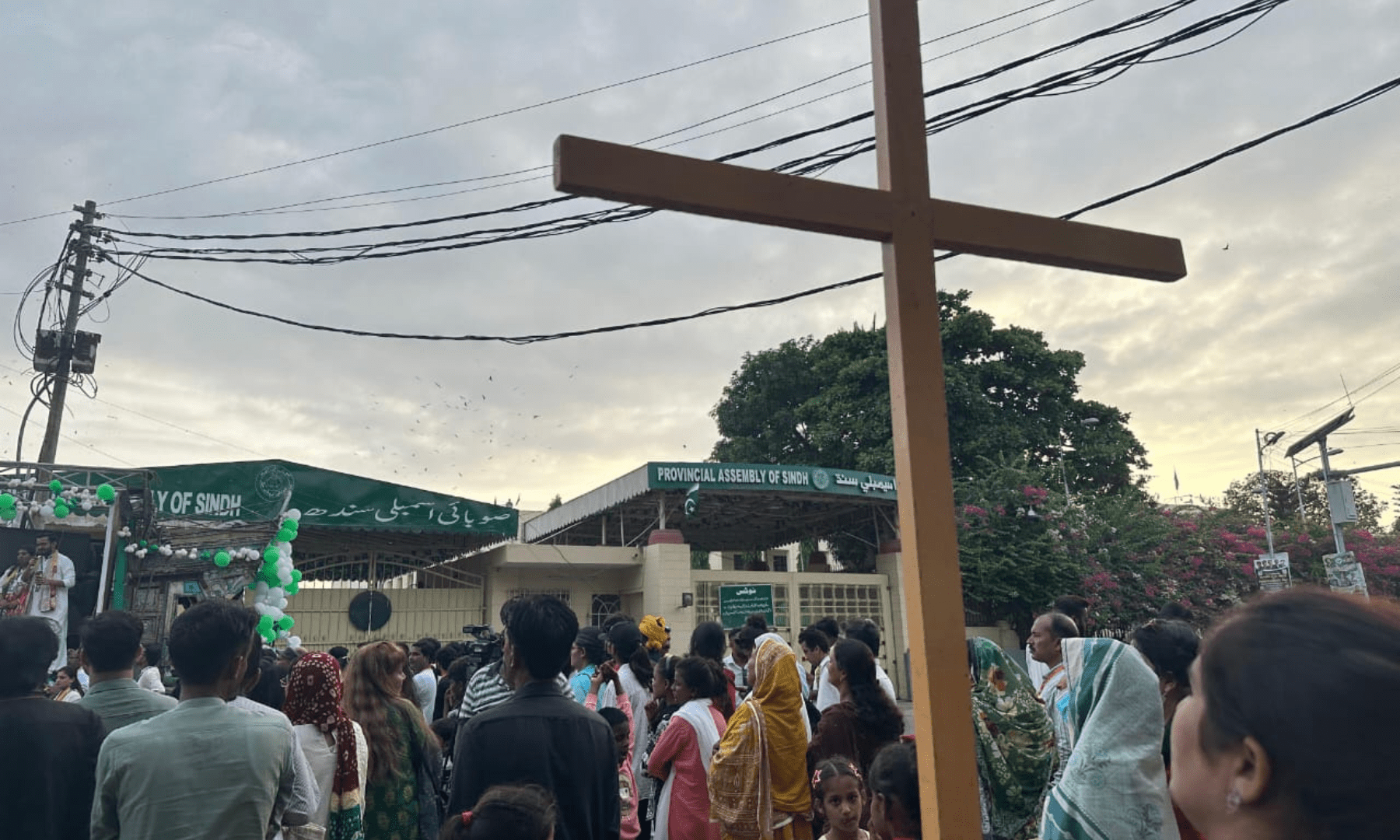
“Chant louder so that it reaches the place where laws are passed,” one of the organisers said as he gestured to the Sindh Assembly behind him, the first legislature to pass a resolution in favour of creating Pakistan.

“We lived here before Pakistan was formed, and we will continue to live here, because, to us, this land’s significance is equivalent to that of our mother”, Maheshwari said.

“We have been fighting all our lives, and we will continue until our last breath.”


Header Image: A woman holds up a wooden cross outside the Sindh Assembly at the Minority Rights March held in Karachi on August 10, 2025. — Photo by Shifa

Courtesy: Dawn News By Anushe Engineer|Shifa “I have a problem with the use of the term ‘minority’. It only serves to otherise religious groups within the country and reinforce existing divides. We are all equal citizens of Pakistan.” Christians like Pastor Daniel were among hundreds gathered at Karachi’s YMCA on Sunday for the Minority Rights March, which, ironically, was celebrated a day earlier since “minorities wouldn’t get a day off to celebrate it”. Jinnah’s oft-quoted speech of Pakistani citizens being free to go to temples and places of worship remains relegated to the history textbooks since the lived realities for religious minorities across Pakistan are far from that freedom once promised. “Christians like me aren’t allowed to preach their religion, and seldom can we
Religious Intolerance – By Asma Ali

By Asma Ali
Master of Arts (MA)
English Literature


Religious Intolerance
مذہبی عدمِ
 برداشت
धार्मिक असहिष्णुता

“We believe that nations are stronger, and the lives of their people richer, when citizens have the freedom to choose, proclaim and exercise their religious identity. We have also learned that the denial of religious freedom or threats to it can cause fear, flight, fighting and even all-out war.”

“Religious tolerance is something we should all practice; however, there have been more persecution and atrocities committed in the name of religion and religious freedom than anything else.”

“Let us have love and more love; a love that melts all opposition, a love that conquers all foes, a love that sweeps away all barriers, a love that abundant in generosity, a large-heartedness, tolerance, forgiveness and noble striving, a love that triumph over all obstacle.”

Introduction:
Intolerance means the refusal to accept views, beliefs, opinions, or behaviors that are different from one’s own. It can lead to discrimination and prejudice against others. Religious Intolerance is looking down on a person or group because of their religion. Religious discrimination is a severe problem in Pakistan that affects not only Christians, Hindus, Sikhs, and Ahmadis, but also minorities from other sects, including the Shia, Ismailis, Bohra, and Hazara communities.

“Adopting an immoderate opinion on a specific issue in a religion is basically known as
religious intolerance”

Religious intolerance is one of the gravest problems of modern society in Pakistan and this
intolerance can be termed as extremism nowadays. In Muslim-majority nations, religion is an all-pervasive force informing and undergirding every part of life. Thus, religious extremism reaches every sphere of Pakistani society, from educational institutions and legal systems to social realities.

Religious intolerance - Newspaper - DAWN.COM

In the 1980s, General Zia al-Haqq led a program of Islamization that has profoundly shaped contemporary Pakistan. Educational curricula promoted an extreme version of Islam. Books were often overtly anti-Christian, and Christians regularly suffered humiliation from their teachers and fellow students. Religious extremism is also reflected in Pakistan’s anti-blasphemy laws, which prescribe life imprisonment for desecrating the Qur’an and a mandatory death sentence for insulting Muhammad. Many Christians have been falsely accused of blasphemy, arrested, and imprisoned or killed.

Freedom of religion in Pakistan is formerly guaranteed by the constitution of Pakistan for the individual of various religions and religious sects. Pakistan was founded in 1947 upon the concept of two nation theory, according to this theory minorities in Pakistan were to be given a fair deal but as the time passed Pakistan became a country dominated by Muslims (Sunnis) and thinking other minorities as inferior to them. When Pakistan came into being Muhammad Ali Jinnah declared that non-Muslims would be equal citizens in the new country.

Religious intolerance towards minorities increasing in Pakistan: UNCIRF

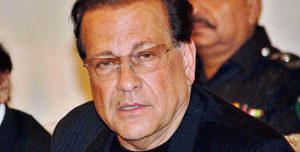
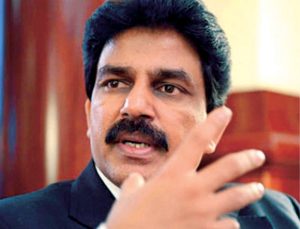
The original constitution of Pakistan did not discriminate between Muslims and non-Muslims. After the incident of 9/11,the Pervez Musharraf government took steps to curtail religious intolerance against non-Muslims. Pakistan blasphemy laws are complicated and questionable both in their form and application. Pakistan’s Minority Federal Minister Shahbaz Bhatti, was murdered on 2nd March 2011 for his lifelong stand against the laws and the governor of Punjab Salman Taseer was killed by his own bodyguard on 4th January 2011 for standing up for a blasphemy defendant.


Salman Taseer

Shahbaz Bhatti

In January 2023, The National Assembly of Pakistan voted to make the blasphemy laws more igniting alarm among minority communities and be used to further target minority communities.

Pakistani Christians played an important role in Pakistan’s independence. When they were in dire need of Sikh, Persian, and Christian minorities’ support, the Supreme Leader and other Muslim leaders promised them equal freedom and rights in the newly established government.

Thus Christians in Punjab and Sindh were fully active after 1945. Christians also supported the idea of a separate Muslim state.

Since Pakistan’s independence in 1947, until the mid-1970s, the Pakistani government was largely secular. But on 26 March 1971, Eastern Pakistan was declared the independent state of Bangladesh, and most of the Pakistani Hindus (who lived in Bangladesh) separated from Pakistan. Meanwhile, Pakistan’s transformation into a culturally integrated and increasingly Islamic state has turned Islam to the source of legislation and a cornerstone of national identity. The governments of Zulfiqar Ali Bhutto and Zia al-Haq therefore took greater Islamic law into account.

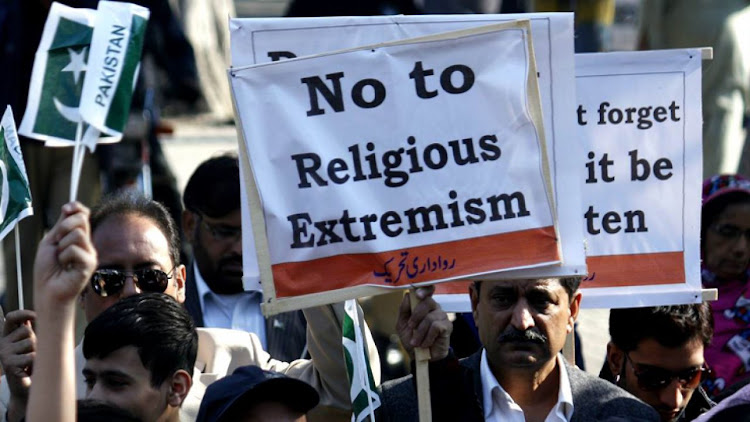
Protest against religious extremism.

Prior to separation from India, Pakistan was a diverse religious and cultural community, but later tolerance to other religions and cultures was reduced. Now, Pakistan is a country where Muslim extremist groups and movements do not tolerate religious minorities. As a matter of fact, Christians have repeatedly been subjected to bloody attacks by extremists.

Pakistani society has become increasingly Islamized and homogenized. As some claim that before the separation, minorities made up 15 percent of the country’s population, but it is currently less than 4 percent.

Many Pakistani Christians believe that they do not have the socio-economic status and equal access to available opportunities, and indeed they are second-class, practically lower-income citizens, and have been denied to become President, Prime Minister, Senate Speaker, or National Assembly Speaker. They also claim that the Christians work in the poorest part of society. In the same vein, some Pakistani think tanks have included Pakistan in the list of a handful of countries that have placed religious minorities under the strongest pressure.

In Pakistan blasphemy allegations are often made on the basis of little or no evidence. Speaking in opposition to Islam is prohibited. Pakistan penal code mandates the death penalty or life in prison for anyone found guilty of insulting the religion or religious figures can be sentenced to death. While authorities have yet to carry out a death sentence for blasphemy, just the accusation can provoke riots.

Countering Homegrown Religious Extremism

There is overwhelming evidence that the laws violate human rights and have encouraged the people to take the law into their own hands. Religious intolerance is deeply rooted in Pakistan’s socio-political fabric. The nation, although founded on principles of religious freedom and equality, has seen growing sectarian violence and discrimination against religious minorities. Sectarian violence particularly between Sunni and Shia Muslims has been a recurrent issue. Extremist groups like the Taliban , Lashkar e Jhangvi, Sipah e Sahaba and Tehreek e Labbaik have perpetrated attacks on Shia communities , leading to significant loss of life. The killing incidents create a climate of fear and insecurity among minorities. Since 2001, more than 2600 Shia Muslims have been killed in violent attacks. Shia, the largest minority group in Pakistan, has been the focus of the most sectarian violence. In 2022, a bombing attack inside a mosque in Peshawar had killed at least 56 people.

The Ahmadi community, a religious minority in Pakistan, is living in fear. They were declared
non-Muslims in 1974. They were banned to ask themselves Muslims and the resemblance of their worship place with the mosque was also banned. Not only Ahmadis are being attacked but almost 74 graves of Ahmadis are broken in Daska, the city of Punjab. Violent mob-attacks on minorities in Pakistan are not uncommon.

In August 2023 thousands of people attacked and burned 24 churches in Punjab. A Christian couple was killed over blasphemy in 2014 by an angry mob and their bodies were burned at the brick kiln where they worked in Kot Radha Kishan, a town in Punjab province.

In Faisalabad, on August 16, 2023, a Christian family was attacked by Muslim men because of accusation of blasphemy. A Christian man Nazir Masih, resident of Sargodha, was attacked in May this year and died because of injuries on June 3, 2024.

Forced conversion to Islam is also a violation of religious freedom and human rights. It is estimated that many people belonging to minorities such as Hindus, Christians and Sikhs are forcefully converted to Islam each year. Specifically, the females are forcefully married and converted to Islam against their will. A Hindu girl, Sohana Kumar Sharma, in Benazirabad district, in Sindh and a Sikh girl in Buner district, in KPK were forcefully converted to Islam although there is no concept of forced conversion in Islam. In Sindh, within 24 hours, two temples were demolished. At the time of partition there were 300 temples in Pakistan but now there are only three dozen that have managed to survive.

The major issues of minority communities were identified as forced conversion and kidnapping of girls and women. — AFP/File

These are only a few instances of religious intolerance and extremism in Pakistan, the purpose is not to point out, but to highlight the problem and think about how to solve it. Illiteracy is one of the biggest causes of religious intolerance in Pakistan.

In Pakistan, lack of religious tolerance is due to the impact of educational curriculum, family
background, history and lack of knowledge about other religions. Pakistani public school textbooks related to non-Islamic faiths and non-Muslims teach bias, distrust, and inferiority. So it is deep rooted in the minds of Pakistani children that we cannot tolerate other religions.
Private religious schools called Madrassas are igniting discrimination by casting Hindus, Christians and other religious minorities in a negative light.

The Educational Curriculum should have the teachings of Religious Harmony to fulfil the purpose of unity. In a household, it’s our duty to teach our children that Religion is someone’s private matter and God has created all human beings equal. Over the last two decades religious political groups have grown into power so the religious minorities are targets of legal as well as social discrimination.

Through genuine dialogue between leaders of all faiths living in Pakistan, religious hatred can be removed. The message to non-Muslims is, “For you is your religion, and for me is my religion.” These
passages counsel tolerance and patience towards other faiths. Therefore, religious faith is a voluntary matter that individuals must choose freely and consciously not compulsively.”

PROTECTING PAKISTAN'S 'OTHER' DAUGHTERS - Newspaper - DAWN.COM

In Pakistan, religious intolerance remains a pressing issue, manifesting in various forms that threaten social harmony and individual freedoms. Discrimination against religious minorities, including Christians, Hindus, and Ahmadis, is widespread, leading to systemic inequalities in education, employment, and social status. Blasphemy laws are frequently misused to target minorities, often resulting in violence instead of justice. The sectarian divide between Sunni and Shia Muslims further creates tensions, with targeted attacks and bombings occurring regularly. Despite constitutional guarantees of religious freedom, the reality on the ground often contradicts these ideals, as societal prejudices and legal ambiguities perpetuate a climate of fear for religious minorities. Addressing these issues requires not only legal reforms but also a concerted effort to promote tolerance, respect diversity, and safeguard the rights of all citizens regardless of their faith. “Laws alone cannot secure freedom of expression; in order that every man presents his views without penalty, there must be a spirit of tolerance in the entire population.”

r/pakistan - a crescent moon and star with text overlayThe founder of Pakistan, Quaid-i-Azam Muhammad Ali Jinnah, envisioned Pakistan to become a peaceful country where all citizens had the right to enjoy equality and were free to practice their faiths.

Conclusion:
It is disheartening to witness the pervasive religious intolerance in Pakistani society. The diversity of religious beliefs should enrich Pakistan’s cultural tapestry, not serve as a source of division and discord. It is imperative for us, as educated individuals, to advocate for tolerance and understanding among all religious communities. By fostering a climate of mutual respect and empathy, we can strive towards a Pakistan where every citizen, regardless of their religious affiliation, can live freely and contribute to our shared prosperity. Let us embrace our diversity as a strength and work together towards a more inclusive and harmonious future for our nation.

“We can never obtain peace in the outer world until we make peace with ourselves.”

If we want to see Pakistan compete in the modern world, we need to end religious differences. We should not be divided as Shia, Sunni, or Christian, but rather come together on one page and rise as a Pakistani nation. As Pakistanis, let’s put an end to religious intolerance and unite for a stronger, more harmonious nation.

In conclusion, religious intolerance hinders Pakistan’s progress and unity. By embracing our shared identity as Pakistanis regardless of different faiths and creeds, we can overcome these divisions.
Ending religious intolerance is crucial for building a cohesive, prosperous nation where
everyone can thrive. The path to a united Pakistan, free from the shackles of religious intolerance, lies in the collective will of its people to embrace diversity and foster mutual respect. By celebrating the rich tapestry of beliefs and traditions that make up the nation, Pakistan can transform its challenges into strengths, proving that unity in diversity is not just an ideal but a tangible reality. It is time for Pakistanis to rise above sectarian divisions, to listen to the stories of their neighbors, and to stand together in the face of adversity. Let the spirit of tolerance and the principles upon which Pakistan was founded guide the nation towards a future where every citizen, regardless of their faith, can thrive in peace and harmony. In this shared vision, Pakistan’s true strength will be revealed, illuminating a path of prosperity, solidarity, and enduring unity for generations to come.

National Minorities Day observed

Disclaimer:
While we hope you find this content useful, it is only intended to serve as a starting point. Your next step is to speak with a qualified, licensed professional who can provide advice tailored to your individual circumstances. Nothing in this article, nor in any associated resources, should be construed as financial or legal advice. Furthermore, while we have made good faith efforts to ensure that the information presented was correct as of the date the content was prepared, we are unable to guarantee that it remains accurate today. Neither Sada-e-Watan (Melody Media Productions) nor its sponsoring partners make any warranties or representations as to the accuracy, applicability, completeness, or suitability for any particular purpose of the information contained herein. Sada-e-Watan (Melody Media Productions) and its sponsoring partners expressly disclaim any liability arising from the use or misuse of these materials and, by visiting this site, you agree to release Sada-e-Watan (Melody Media Productions)  and its sponsoring partners from any such liability. Do not rely upon the information provided in this content when making decisions regarding financial or legal matters without first consulting with a qualified, licensed professional. 
By Asma Ali Master of Arts (MA) English Literature   Religious Intolerance مذہبی عدمِ برداشت धार्मिक असहिष्णुता “We believe that nations are stronger, and the lives of their people richer, when citizens have the freedom to choose, proclaim and exercise their religious identity. We have also learned that the denial of religious freedom or threats to it can cause fear, flight, fighting and even all-out war.” “Religious tolerance is something we should all practice; however, there have been more persecution and atrocities committed in the name of religion and religious freedom than anything else.” “Let us have love and more love; a love that melts all opposition, a love that conquers all foes, a love that sweeps away all barriers, a love that abundant in
Faith Under Fire … Religious Intolerance.

By Areeba Khan
Master of Business Administration
MBA
Image: Dawn

Religious Intolerance
مذہبی عدمِ
برداشت
धार्मिक असहिष्णुता

Faith Under Fire

“In every religion, there are those who would drape themselves in the mantle of belief and faith only to distort it’s most sacred teachings – preaching intolerance and resorting to violence.”

“Never, never, never join a movement that persecutes people because of their faith.”

“The greatest problem in the world today is intolerance. Everyone is so intolerant of each other.”

“Tolerance is a good cornerstone on which to build human relationships.”

Premium Vector | Pakistan Flag Glow In Sunset background

Religious discrimination in Pakistan is a serious issue for the human rights situation in modern-day Pakistan. Hindus, Christians, Sikhs, Shias, and Ahmadis among other religious minorities often face discrimination and at times are even subjected to violence.

Why Religious Intolerance Makes Me Mad – Groundviews

Human rights activists reported numerous instances of societal violence related to allegations of blasphemy; of efforts by individuals to coerce religious minorities to convert, and of societal harassment, discrimination, and threats of violence directed at members of religious minority communities. NGOs expressed concern about what they stated was the increasing frequency of attempts to kidnap, forcibly convert, and forcibly marry young women and girls from religious minority communities, especially Hindus and Christians. Estimates of the number of forced or coerced conversions vary widely – from as few as five per year to as many as 500. The NGO Center for Social Justice recorded 124 cases of forced or coerced conversions of young women and girls through marriage during the year, an increase of 59 percent over the organization’s count of 78 cases in the previous year. There continued to be reports of attacks on Ahmadi, Hindu, and Christian holy places, cemeteries, and religious symbols. Civil society groups and some religious leaders continued to express concerns about the safety of religious minorities.

Abuses against women and girls – including rape, murder through so-called honor killings, acid attacks, domestic violence, and forced marriage – remained common in 2023-2024.  It’s very common, religious extremists committed a series of acid attacks on women in the Balochistan province.

Pakistan has grappled with religious intolerance, fueled by the intertwining of politics and blasphemy laws. The recent incident in the small town of Jaranwala in Punjab, which led to a series of attacks on churches, following accusations of blasphemy, spotlights this ongoing issue. Weak governance structures and unchecked clerical power worsen the problem.

Religious intolerance - Newspaper - DAWN.COM

Pakistan’s Christians account for around 1.5% of the country’s mainly Muslim population. Persecution of the minority in the past has largely been linked to a controversial blasphemy law, which allows anyone to accuse a person of insulting religion, without having to produce evidence. The law has often been abused to target minorities, settle vendettas and personal disputes.

Christians are not the only minority to be targeted. Pakistan is a majority Sunni Muslim country and sectarian attacks against its Shia Muslims have included several bombings that left hundreds dead. The country’s Ahmadi community – a breakaway sect of Muslims declared non-Muslims for their religious beliefs – have long been persecuted.

Terrorists have targeted people in places of worship across the country – Shia imambargahs, Sufi shrines and Sunni mosques have been bombed or attacked by gunmen.

More deadly

Attacks against minority groups in Pakistan are on the rise. Each year is becoming more deadly than the last according to human rights groups, which have been keeping tally on the startling statistics.

Pakistan is home to multiple minority communities who are often the victims of proselytisation and other forms of systematic oppression, persecution and opportunistic violence. For Christians, in particular, Pakistan is considered the seventh most dangerous country to live in by the World Watch List 2023. Moreover, the International Christian Concern has documented more than 300 cases of Persecution against the Christian community from 2019 to 2021, ranging from accusations of blasphemy to forced conversions and mob-led violence. The legally ambiguous nature of the blasphemy laws is often misused with impunity, fostering an unfortunate culture of mob mentality and vigilantism across the country. Pakistan’s government did little to stop the rising toll of killings and repression by extremists groups that target religious minorities.


Christians in Pakistan Strive for Equality as Elections Near - International Christian ConcernChristian community in Pakistan

Hazara Shi’a community in Pakistan
Hindu community in Pakistan

In Pakistan, religion has been serving a very controversial purpose. Pakistan was established in 1947 on the basis of Islamic fundamentalism, it is home to many communities, such as Ahmadis, Christians, Hindus, and Sikhs and many more.

South Asia’s problems with religious liberty and intercommunal violence are intricate and have long historical roots. The reason behind partition was to provide a separate land for majority that now lives in Pakistan to have freedom go living their life according to their religious beliefs. When the British ceased their colonial control in the Indian Subcontinent in 1947. But the greatest departure in human history quickly turned into a widespread partisan slaughter, with hundreds of thousands lost in rioting between Muslims and Hindus and Sikhs. The division’s wounds continue to fuel Indo-Pakistani competition and shape their opposing views of what it means to be a nation. Now India is a secular state and Pakistan is Home to the majority.

Men, part of an angry mob, react after burning belongings of Christian families, Lahore, March 9, 2013. —AP/FILE

For example, Even though people of these countries are protected by International laws, where there religious rights are safe guarded along with their rights as a minority, the reality is different. Religious discrimination and persecution is still an underlying issue in Pakistan. People are still tortured in numerous ways including physical attracts, economic enslavement and making them outcasts.

The biggest reason can be the political and historical events this region has been through. There’s always been inequality between genders and biasedness of the society. The tears of faith has not been dried up from the memories of tormenting religious partition that took place in august of 1997. These partitions would have been beneficial if religion was not too effective on the politics.

The founding father of Pakistan Played a key role in resolving the issue of conflicts between the religions. He even said on 11th august 1947 “You may belong to any religion or caste or creed – that has nothing to do with the business of the state … We are starting with this fundamental principle that we are all citizens and equal citizens of one state”
Image preview
Religious extremism is a grave menace to Pakistan’s human rights situation in the modern-day world. Hindus, Muslims, Sikhs, Christians and other religious minorities in Pakistan face frequent discrimination. They feel threatened in their homes and working places in Pakistan. When Pakistan was founded in 1947, its makers had dreamt of founding a secular state, where every individual regardless of their faith would be given equal opportunities and allowed to live their life freely. But, things are vice versa in modern-day Pakistan which does not reflect the vision of Quaid and Iqbal.


Additionally, things have worsened in the past few decades due to a combination of certain factors which include a radicalized Pakistani society, an educational institution that breeds hatred and a set of laws that Muslim majorities use against other minorities for their vendettas.

The country might be made in the name of one religion but it was not welcoming to all. Founding father tried but the people did not. The main reason was to unite all the people and nations under one roof for the betterment of the People as a whole. Because the majority and its religion was supposed to be a unifying force for all. Remember no religion supports violence. So it was their responsibility to protect the rights of the others and to uphold the principles of religious rights along with the Human rights.

Let’s discuss few points that might be the reason for the fire that burns behind the false facade of humanity and unity.

Current Political situation:

Pakistan has been going through political instability since birth and there were more dictatorship regimes than democracy. All those times were consisting of laws that belonged to majority’s sharia. Again following sharia is not wrong but making others feel uncomfortable is. Pakistan gave rights to minorities to choose their leaders but forgot to give them powers with that. So minorities never actually enjoyed the freedom. There’s always a cloud of terror surrounding them because they know nobody would be coming for help. Pakistan today is going through roughest trial of the existence. Political instability has never been this bad. There’s been many cases of religious turmoil in this regime alone. Nothing has been done for the relief of people who suffered. Media play shows otherwise. But behind the camera people are still waiting for aid after losing everything in the hand of Mob that lacks reality check. How ironic it is that all the cases from current political regimes are false and result of personal grudge. However government failed to protect its own citizens.

Education system of Pakistan:

One of the main reason that education system religious system ferociously dictates is Prejudice. It has been established that the textbooks showcase intolerance and it provides young people very inaccurate knowledge about the minorities. The curriculum is very outdated. It almost never stated anything good regarding religious minorities. Even their contributions in making of Pakistan are neglected. The current contributions are not taken into account either. It also do not address concerns of religious plurality or tolerance/intolerance. This ultimately breeds bigotry and ignorance. The system is giving an option to minorities to study compulsory Ethics but very unfortunately teachers are not ready to teach. And during exams children studying ethics are treated differently. Schools or work place minorities are harassed. This type of behavior leads to inferiority complex in young minds.

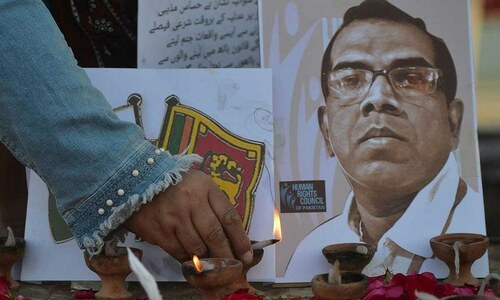
The bare minimum - Newspaper - DAWN.COMPriyantha Kumara, a Sri Lankan, was brutally murdered
in Sialkot, shames the nation.

Media of Pakistan:

Media in Pakistan is known for being partial. Its Media shows an example of sheep tricks. The media conceals the problems and unfair treatments that happen to minorities. And if it’s reported it’s mostly misinformation and very precise information. Harmful stereotypes and distorted views are of the most dangerous thing that is happening right now. Media is consumed on daily basis and that is why correct and current information is necessary. There are many transmissions and other things that happen to exist along with the hundreds of the channels. It’s not wrong to glorify ones belief but forcing it on others is. It’s like living in someone else’ house and it’s awkward all the time.

Laws and trends:

One takeaway in all such circumstances remains common: in a society governed by the rule of law, individuals must refrain from assuming the role of judge, jury, and executioner. The recent surge in cases where people have resorted to acts of violence against the accused without due process and concrete evidence is not only deeply harrowing but also undermines the very foundations of justice our country was established on – perpetuating a dangerous cycle of vigilantism.

While it is understandable that emotions may run high in the face of heinous crimes or perceived injustices, it is crucial to remember that our legal system is designed to ensure fairness and impartiality.
By taking matters into their own hands, individuals also risk compromising the integrity of the judicial process. The principle of “innocent until proven guilty” is a cornerstone of any civilized society. It serves as a safeguard against the potential for wrongful convictions and protects the rights of the accused. By bypassing this fundamental principle and resorting to violence, individuals not only deny the accused their right to a fair trial but also implicate themselves in the process.

To address these underlying issues, public awareness campaigns are crucial to shed light on the consequences of making false accusations, as well as provide guidance on how to navigate such situations, should one encounter them.

Pakistan’s Blasphemy Laws are just for targeting already hurting minorities and it is just promoting the ongoing prejudice. Unfortunately it’s also used to blackmail the rivals. Despite the fact this Law was supposed to protect and safeguard the people. This results in dangerous consequences and executions, violent crimes and it also creates a sense of hopelessness because people don’t find any justice. There’s been countless cases that led to riots and torturous situations. There were cases where people were killed just on the basis of suspicion. Drinking water from a tap can be a reason for blasphemy in Land of Pure. Out of all things when the justice system fails everything else fails as well.

There are deliberate attempts to put people into situations that are uncomfortable, so trends that can be harmful shouldn’t be supported in any way.

Addressing Extremism And Promoting Religious Tolerance In Pakistan

Family and Upbringing:

Family attitudes and religious instruction within household, schools and work places. It can shape individuals mindsets and contribute to the continuation of Hostility and sense of discrimination towards minorities.

Solution:

Eradicating religious intolerance is a many-sided venture that needs efforts on several levels. Here’s what we can do:

Education:

In the intricacies that characterize interfaith relations, lack of education plays a significant role in escalating tensions. Ignorance and misinformation thrive when people lack proper knowledge and understanding. In a world where quality education is a privilege, not everyone has the opportunity to objectively assess religious matters. Many people have limited access to information, making them susceptible to manipulation and extremist influences. This vulnerability can lead to tragic incidents like the recent attack in Jaranwala. Education is essential in fostering tolerance and preventing such conflicts.

Considering our changing educational landscape, comprehensive education reforms must be prioritised. As we mold the minds of future generations, our curriculum must incorporate values like religious tolerance, critical thinking and human rights. Religious tolerance, in particular, is a fundamental building block of a harmonious society.

In a world where access to quality education remains a privilege rather than a right, individuals find themselves at a disadvantage when it comes to objectively evaluating religious issues. The generalized and easily influenced mind that remains, thereof, leaves them vulnerable to manipulation and extremist influences, ultimately leading to tragic incidents such as the recent Jaranwala attack itself.

If the syllabus is updated and People are taught about minorities and their achievements it might help everyone to know that co-existence is doable. Diversity is beautiful and there are many people around us, and they should have rights to live and not just that but also to live according to their religion. Apart from that families and elders must educate their children. This can cure the root cause of hate and superiority complex.

Countering hate speech:

Addressing hate speech and promoting persuading communication can help create more tolerant environment. It will help others to understand that the issue is very delicate. It will also motivate them to respect others and to treat them equally.

Legal Protections:

There should be laws and proper ways to protect people who needs protection. There should be severe punishments for the people who misuse the law and hurt minorities. There should be strict actions against people who vandalize and harass others. Mob mentality must not prevail.

Minority should be allowed to live their lives according to their religion. They should be allowed to study about their religion or ethics without the fear of getting bullied for it.

Promoting the interfaith dialogues:

As it is said “Communication is the key”. It can be very beneficial for spreading awareness. Pakistan’s government should ensure the security of the country’s religious minorities from judicial injustice and attacks by militants, Human Rights Watch. 

In the intricate tapestry of interfaith relations, one cannot overlook the profound impact that a dearth of education has on exacerbating tensions. It is an unfortunate reality that ignorance and misinformation thrive in the absence of proper knowledge and understanding.

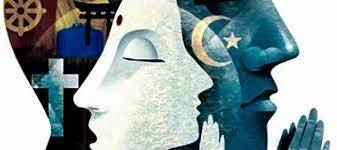
National unity and harmony can bring peace and stability in the country: Analysts

Conclusion:

Amidst a critical juncture in Pakistan’s history, the discourse surrounding Jaranwala has underscored the imperative for resolute measures that go beyond mere rhetoric. It calls for concerted efforts to eradicate extremism and safeguard the country’s rich tapestry of diversity.

At the same time, raising a voice for victims of intolerance and bigotry has become increasingly challenging in a hostile environment. Blasphemy accused often cannot find lawyers to defend them, and the media, particularly in Balochistan, is menaced by threats from various quarters, including religious extremists.

Despite the state’s realisation, at least in part, of the folly of using religious proxies to further political ends, it appears unwilling, or unable, to take the bull by the horns. It is a mark of shame that those who fuel the flames of intolerance and carry out their blood-soaked agenda do so largely with impunity in Pakistan.

In today’s world, marked by social progress is a critical need to reaffirm our commitment to diversity and combat intolerance. These goals offer hope for a more inclusive and harmonious future, but it’s important to recognize that, while they point the way, humans must actively work towards these goals themselves.

In addition, the state must assume the responsibility of safeguarding the rights of the accused, ensuring that they are shielded from any form of extremist retribution. In this era of evolving educational paradigms, we must turn our attention to the pressing need for comprehensive education reforms.

As we strive to shape the minds of future generations, our curriculum must reflect the values of religious tolerance, critical thinking, and human rights. Religious tolerance, a cornerstone of a harmonious society, must be nurtured within the educational framework.

By fostering an environment that encourages understanding and respect for diverse religious beliefs, we equip our students with the tools to navigate an increasingly interconnected world. In doing so, we cultivate a generation that embraces diversity and promotes inclusivity, fostering a society that thrives on mutual respect and understanding.

Pakistan is suffering from many issues but religious intolerance is not only dragging the country through mud but also making people scared and tired of this never ending saga. Educated work force is leaving country and by few years only uneducated people will be left here. That is why we need very brave leadership and strong laws. And institutes that can enforce that law. Strong legal actions are needed to set examples. It is need of the time. It’s now or never!

Disclaimer:
While we hope you find this content useful, it is only intended to serve as a starting point. Your next step is to speak with a qualified, licensed professional who can provide advice tailored to your individual circumstances. Nothing in this article, nor in any associated resources, should be construed as financial or legal advice. Furthermore, while we have made good faith efforts to ensure that the information presented was correct as of the date the content was prepared, we are unable to guarantee that it remains accurate today. Neither Sada-e-Watan (Melody Media Productions) nor its sponsoring partners make any warranties or representations as to the accuracy, applicability, completeness, or suitability for any particular purpose of the information contained herein. Sada-e-Watan (Melody Media Productions) and its sponsoring partners expressly disclaim any liability arising from the use or misuse of these materials and, by visiting this site, you agree to release Sada-e-Watan (Melody Media Productions)  and its sponsoring partners from any such liability. Do not rely upon the information provided in this content when making decisions regarding financial or legal matters without first consulting with a qualified, licensed professional. 
By Areeba Khan Master of Business Administration MBA Image: Dawn Religious Intolerance مذہبی عدمِ برداشت धार्मिक असहिष्णुता Faith Under Fire “In every religion, there are those who would drape themselves in the mantle of belief and faith only to distort it’s most sacred teachings – preaching intolerance and resorting to violence.” “Never, never, never join a movement that persecutes people because of their faith.” “The greatest problem in the world today is intolerance. Everyone is so intolerant of each other.” “Tolerance is a good cornerstone on which to build human relationships.” Religious discrimination in Pakistan is a serious issue for the human rights situation in modern-day Pakistan. Hindus, Christians, Sikhs, Shias, and Ahmadis among other religious minorities often face discrimination and at times are even subjected to

Disclaimer:
Sada-E-Watan provides news and opinion articles as a service to our readers. These articles and news items come from sources outside of our organization. Where possible, the author and the source are documented within each article. Statements and opinions expressed in these articles are solely those of the author (reporter/newspaper) or authors (reporters/newspapers) and may or may not be shared by the staff and management of Sada-E-Watan. Sada-E-Watan was created to provide one convenient central location where a user can quickly scan headlines from many news sources. The headlines listed on Sada-E-Watan pages are links to stories on the sites where these stories are located. The goal of Sada-E-Watan is to help readers access stories on web sites that they would normally not have time to view on a regular basis and to add value to the news source sites by mentioning their name on top, so readers can view these sites..

The Sada-E-Watan takes no responsibility for any loss or damage suffered as a result of using the linked websites or as a result of using the information published on any of the pages of the linked websites.

Whilst every effort is made to ensure downloadable content is free from viruses, Sada-E-Watan cannot accept any liability for damages resulting from virus infection. You should take adequate steps to ensure your virus check regularly when using any device.

If you have any questions or comments about Sada-E-Watan, please contact us at: radio@sada-e-watan.com